
Typical of most our days this February, it was raining on the morning of our monthly herb walk. However, a trusty group were undeterred so the dozen or so of us, and slightly fewer umbrellas, enjoyed the walk along the Cam in Littlecombe.
First leaves
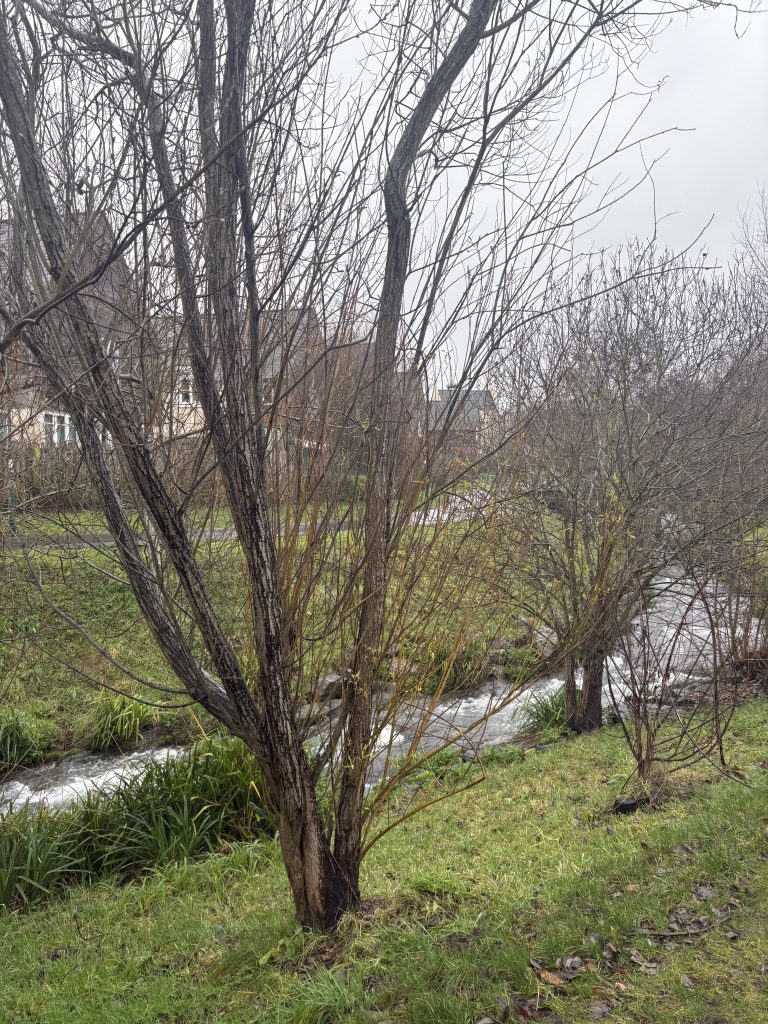
Our first pause was appropriately by the willow. This is revered for being one of the first trees to come back into leaf after winter, and so holds an important place in tradition and myth, connected with deep emotions and renewal. The qualities willow was believed to hold made it a popular choice for making wands.
As a tree of beginnings, willow is said to help us look forward. Standing close to a willow may even awaken psychic abilities, or slipping willow under a pillow on a full moon can bring about night visions. At the more unsettling end of the spectrum, the ‘willowiness’ of the tree, the way it swishes and sways, can be associated with bending and and manipulating. Masters of enchantment and shape-shifting sorcery, the Wiccan people were named after the willow.
In modern times we can take the endurance of the willow as a positive support. It stands tall against the winds of change, willing to bend while maintaining inner strength. Willow can show us how to thrive and survive, even in turbulent times.
Practically speaking, willow is a key ally against seasonal colds and flus, as well as helping reduce inflammation, such as we get with rheumatism, when we feel the cold in our bones. Any ailment that we might take an aspirin for may be helped by willow, for willow bark was the original source of the salicylic acid that gives aspirin its power.
Willow bark has been used in other ways too. It can make a good rope and used as a natural dye it yields a reddish colour.
Willow’s latin name is ‘Salix’, there are more than 350 different types of salix across the globe. To find willows, head to water. Their name probably has some connection with the Celtic terms ‘sal’ meaning near and ‘lis’ meaning water.
River exposed
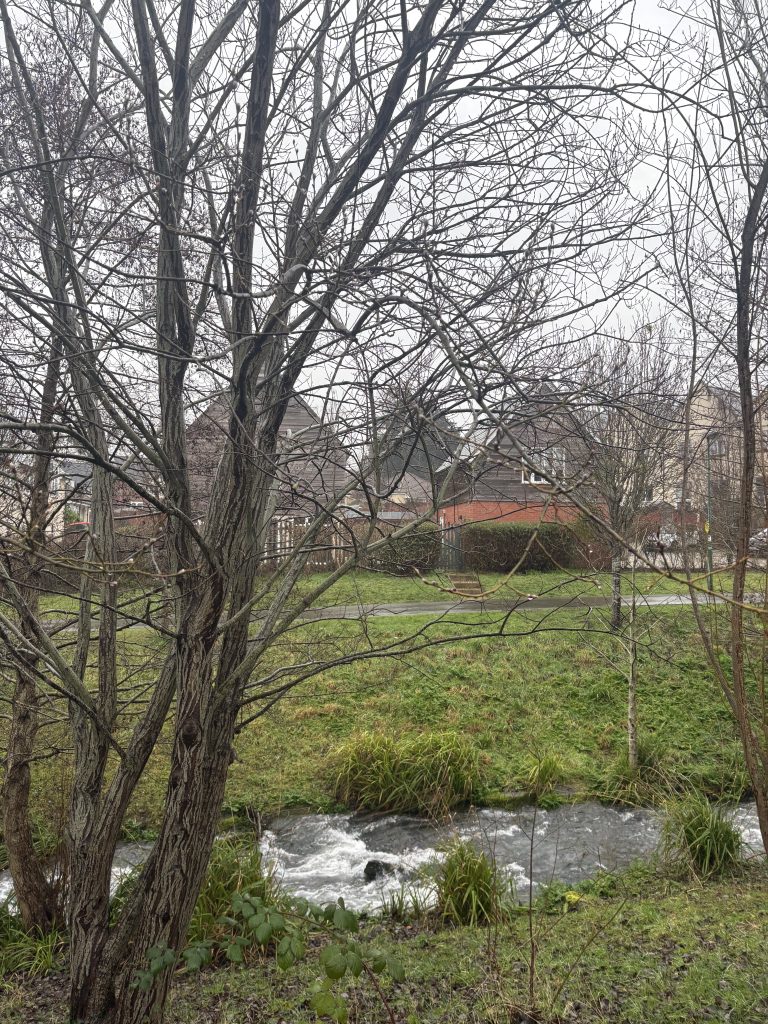
The free-flowing burbling River Cam is a haven for nature running through the Littlecombe estate. For years it ran in a culvert under the Listers factory site and may have remained buried if it hadn’t been cheaper to expose the river (instead of managing its underground flow with a costly pumping station). The naturalising work has included adding reed beds at alternating stations down the river bank, encouraging a meandering that will, overtime, allow the river to create it’s own path along the valley.
First flowers
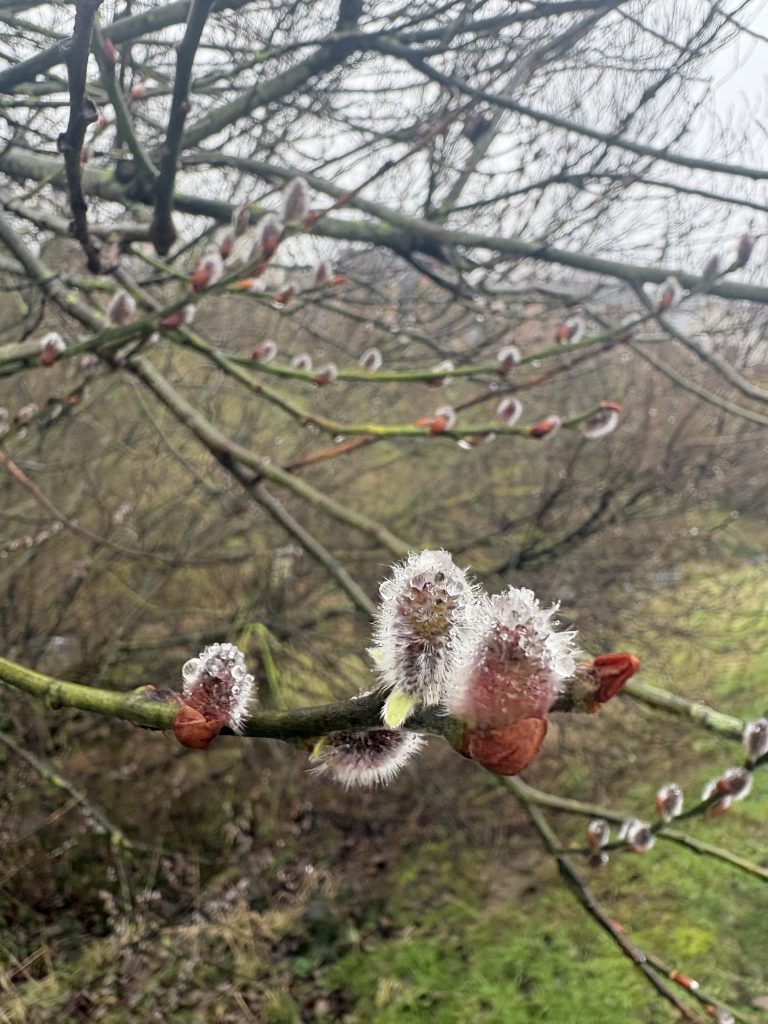
We often associate Spring with the delicate blossoms of cherry and apple and others, typically all in the Rosacea family. But before them, the flowering of many other types of tree, including willow, hazel, alder, birch, oak and poplar, is in the form of catkins. A really important source of early nectar for bees and insects, and possibly kick-starting allergy season for other sensitive beings.
Coming in this early part of the year they too are associated with renewal and are a favourite symbol of Brighid, the goddess celebrated in the Celtic festival of Imbolc that falls at the start of February. The coming of spring is associated with Brighid spreading her green mantle across the earth, and the stirring of new life. Catkins are therefore associated with fertility and a branch of catkins will often be hung in lambing barns. More generally they may be hung as a protection against evil, or against thunder and lightening. Trees decorated with catkins are sometimes called ‘fairy trees’, more due to their delicate appearance than any believed magical properties.
February traditions
Alongside Imbolc, the Christian equivalent festival is Candlemas. Snowdrops are the flower most associated with this time. Traditionally these should not be brought indoors, except for on Candlemas itself when the altar can be decorated with them. There were some ‘February Fair Maids’ (as they’re sometimes known) along our path.
Always look up as well as down to see the full array of plants. High up in the branches was a ball of mistletoe, appropriate perhaps for another February celebration of Valentine’s Day, as mistletoe is considered to be an aphrodisiac (possibly due to the figurative arrangement of its berries atop a long leaf). Of course, it has a long association with kissing too.
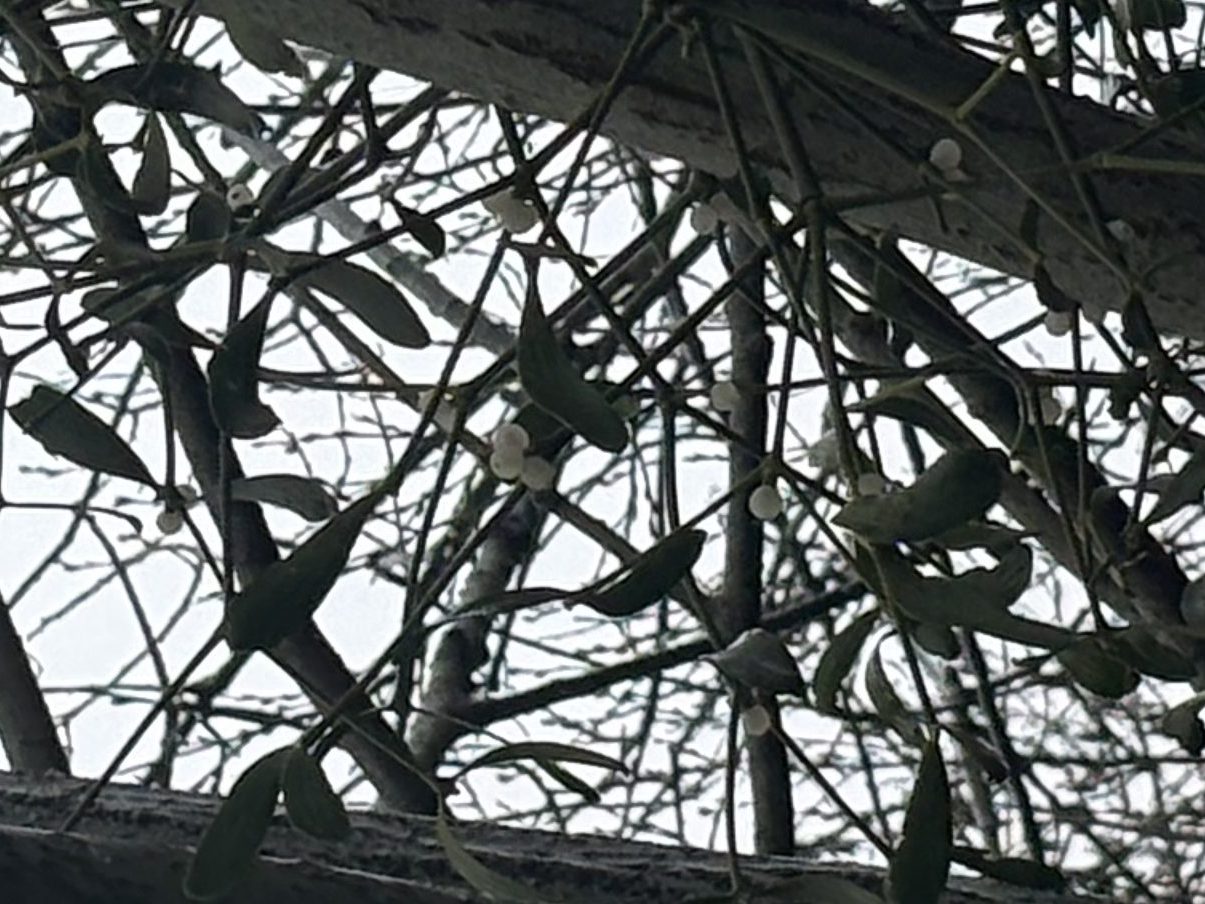
Magical properties associated with mistletoe are because it stays green, even when its host tree has lost its leaves. Medical properties associated with mistletoe are because it is considered helpful in shrinking tumours and lowering blood pressure. Not one to be used as a home remedy as the berries are poisonous. Traditionally mistletoe for kissing under should be gathered from an apple tree so it brings good luck; mistletoe for medicinal use should be gathered from the hawthorn; and the most sacred mistletoe is gathered from oak.
The silhouette of mistletoe stands out well in the bare branches of trees at this time of the year and we see it often locally as it is considered to be highly prevalent in counties that border the River Severn.
Magic and mystery
Our next magical plant was the purple-flowered hellebore, a plant of the poison path, long associated with witches’ gardens. Dark flowered plants are often associated with magic and also with some extreme medicine (the difference between a poison and a cure often being down to dosage). Hellebore’s reputation as a cure for mania goes back to Greek times with Hippocrates. By Roman times Pliny was suggesting it could be used in exorcism. The witches’ typical use of the plant is even more mystical, powdered and sprinkled it was said to enable shape shifting and invisibility.
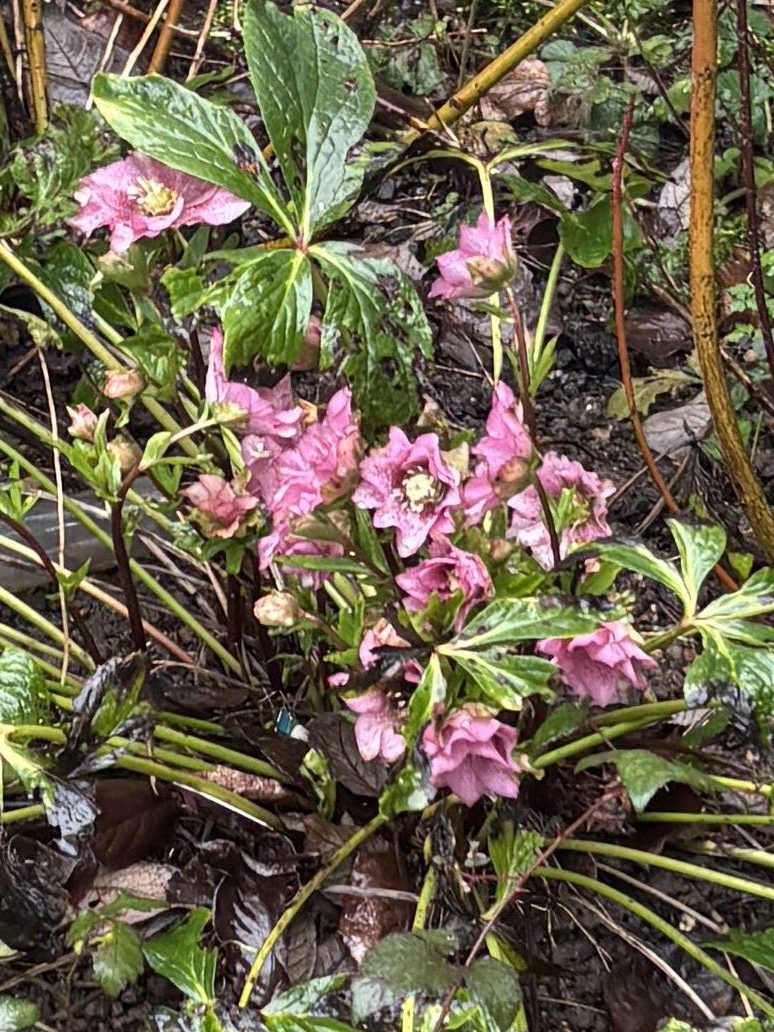
We often delight in hellebore as one of the first flowers of the year with it’s elegant bent heads encouraging us to take a closer look. It may be this downcast stance, or the early seasonal cheer that leads to it often being planted on graves. Or maybe this is due to its sombre colours. Or maybe simply because its a flower that doesn’t need much looking after.
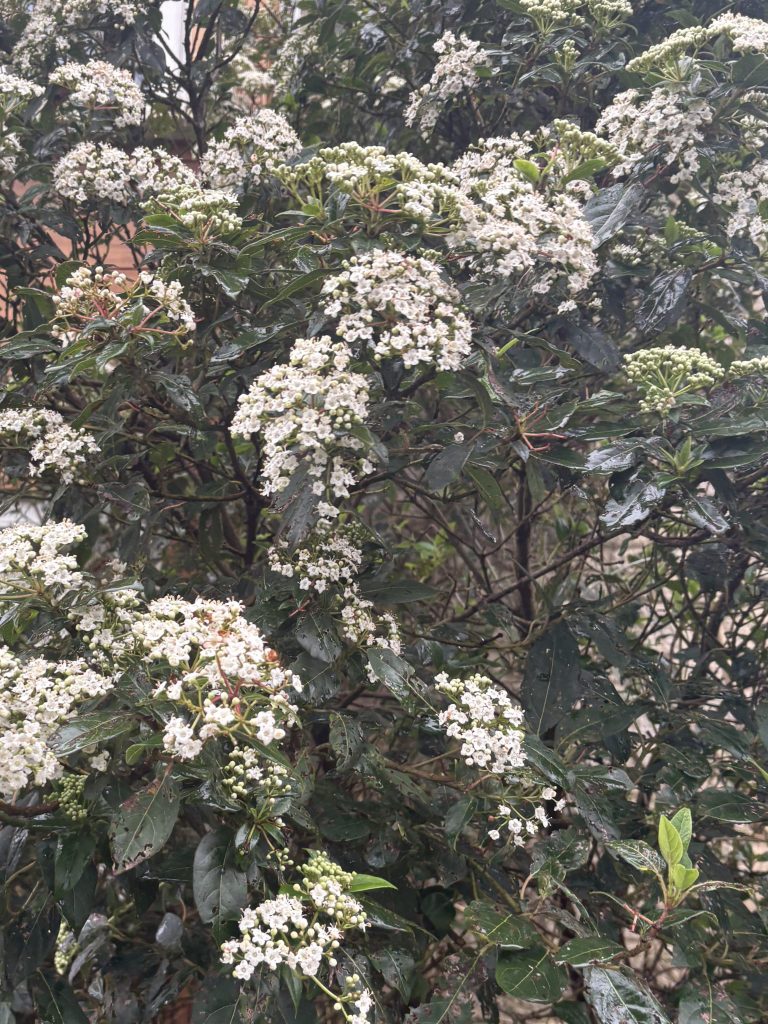
Another welcome dose of early season flowers, and scent, come from viburnum. This shrubby plant with dark green leaves and balls of small white or pinkish flowers is often overlooked at other times of the year. In this season, once you start spotting them, you will keep seeing more. And they will often be near a front door or driveway. I wonder how many people planting them today are aware of their association with warding off evil and appreciate the protection they bring?
There are plenty of patches of grass along the way, visual breathing spaces between the roads and houses, but also worth closer inspection. Along with scatterings of daisies (a plant to turn to for restoring joy and enthusiasm so always a gladdening sight) and regular sitings of ground ivy (commonly known as ale-hoof for its use in flavouring beer) there were also the first indications of orchids. In this early part of the year, just a small, strappy green leaf, but potentially bringing delicate pinky purple flowers in a few month’s time. Definitely worth a return trip in early summer to see what may be on show then.
Spring clean
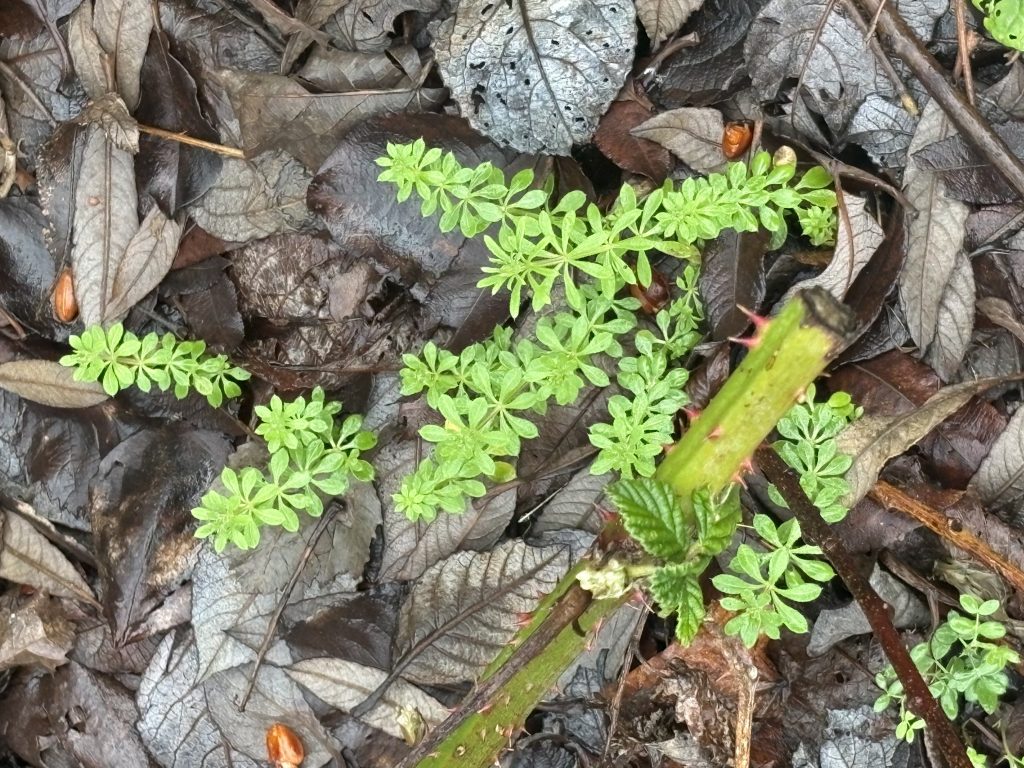
One of the delights of this time of the year, that’s really coming into its prime season right now, is goosegrass. Which you may know as cleavers, or sticky weed, sticky willy, or any number of local names. Or maybe you don’t know its name at all, but recognise the scrambling whorls of leaves that can be pulled by the fistful from garden borders, or teasingly thrown to stick on another’s back.
Often growing abundantly, cleavers has been put to many uses in different times and cultures. Like creating a makeshift sieve. Or adding it to milk to coagulate, creating curds – this is a practice from Turkey where the plant is known as ‘yoghurt herb’. I have given it a go (first crush the stems to release the plant’s juice and add to nearly boiling whole milk) but so far without much success.
Within herbal medicine, cleavers is upheld as the great lymph cleanser. It’s branching nature is likened to the branches of the lymph system through our body. An infusion of cleavers (simply putting the stems in cold water) can be drunk throughout the day as cleansing spring tonic. Make the most of this plant while it is lush and vibrant, it needs to be used fresh and, unusually for a herb, loses its key properties when dried.
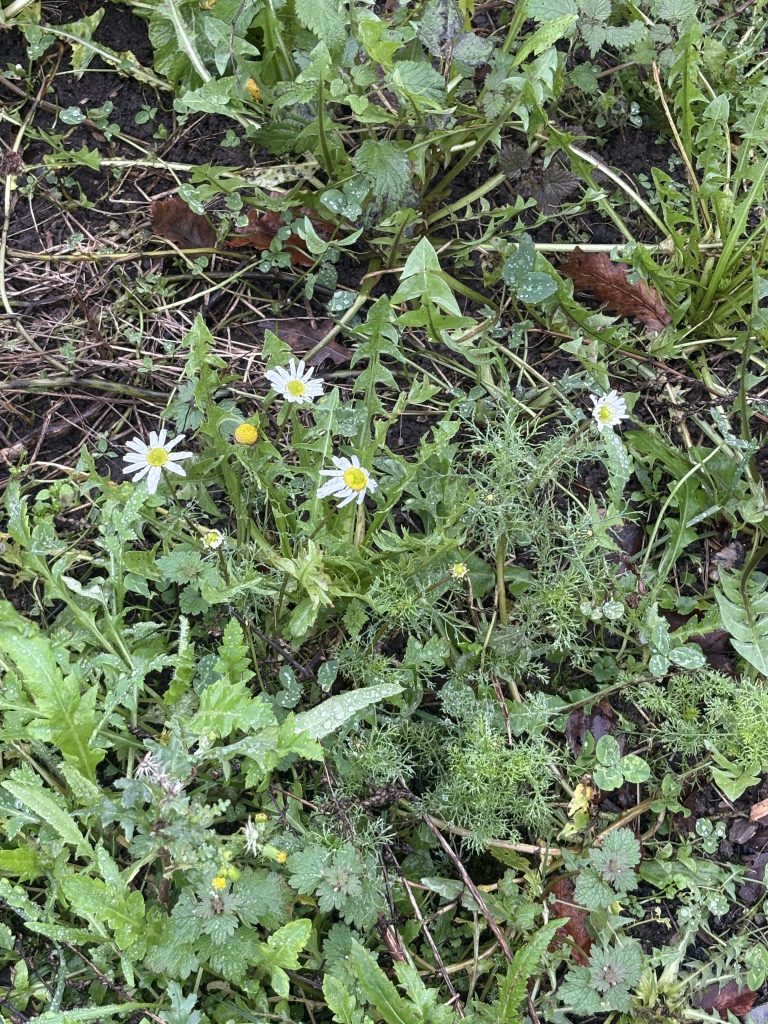
And a little surprise at the end of our walk, some very, very early chamomile.

Leave a Reply