
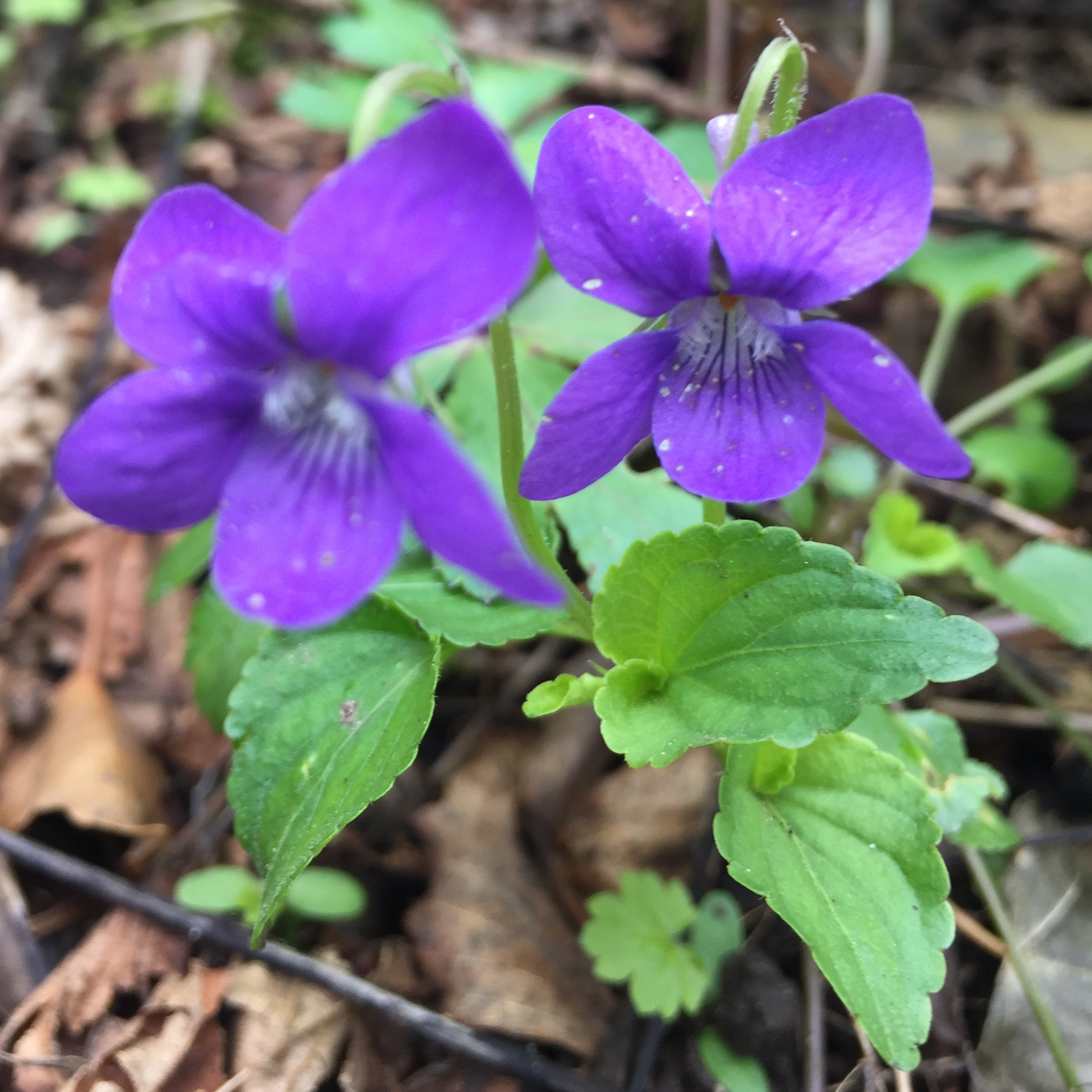
One of the first woodland flowers to bring delight, once the initial flurry of snowdrops is passed, are violets. If you’re lucky, you’ll catch their scent on the air when a patch of their purple or white flowers is nearby.
Gerard summed up violets as
‘delightfull to looke upon and pleasant to smell’
John Gerard
Sweet violets
These are the qualities that have ensured violets have a familiar place in our hearts and are perhaps one of the best know wild flowers. As Culpeper agrees, they are ‘so well known they need no description’. Apart from the small differences between ‘violet’, ‘sweet violet’ and ‘wild violet’, I have not been able to find any more common names for the sweet violet, Viola odorata. Which attests to the huge commonality, distinctiveness and recognition of these violets.
There are many other types of violet (over 100 species in the Viola genus, five of which are native to Great Britain) – including dog violet, water violet, hearts ease, etc – all of which have many common names, but sweet violet is rarely known by any other moniker. It is also the only scented violet, a clear point of distinction.
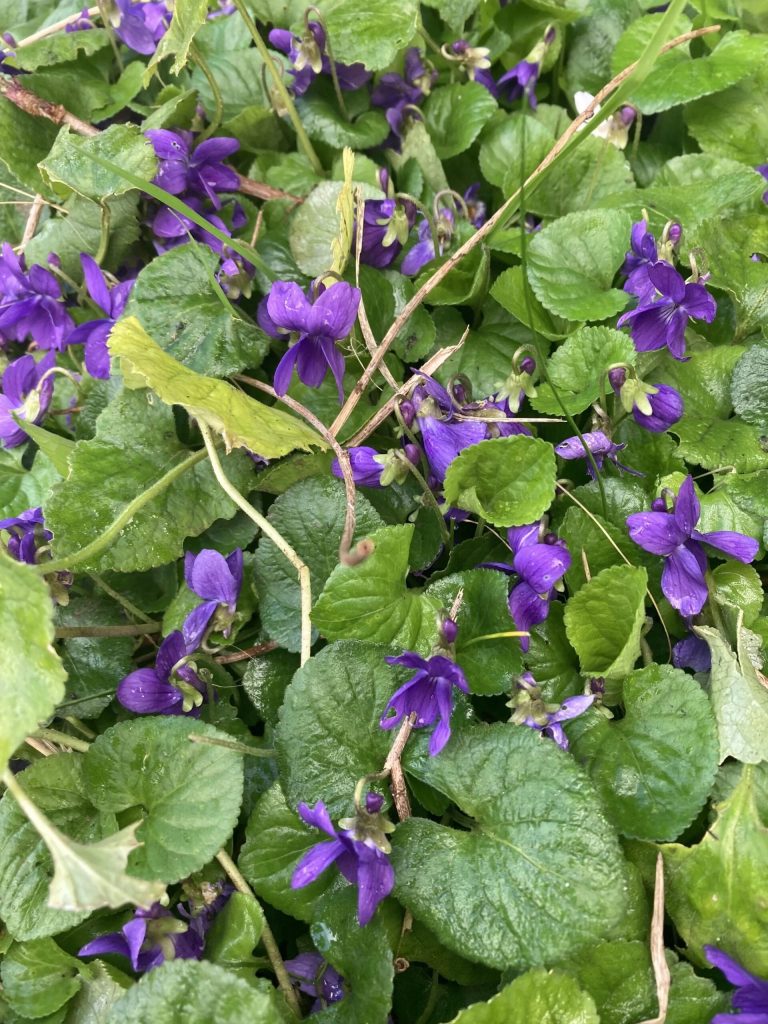
The key characteristics of sweet violet are its heart shaped leaves (that are slightly downy on the underside), down-hanging flowers (typically violet in colour, but can be anything from this to lilac or white) and that sweet scent with a cool moss-like edge.
Self-fertile
Curiously, the flowers that appear in the early part of the year don’t generally produce seeds. They are designed to attract bees as pollinators, being full of nectar, but typically flower before there are many bees present, so they rarely set seed. Instead, the plant reproduces through runners that spread after the early flowering. There is a second flowering in the autumn, of scentless, petal-less flowers which are so small they are hidden among the foliage, though these often go unnoticed, they can produce many seeds.
Violets are widespread, although plants of the genus do vary regionally. Throughout temperate regions they are found as herbaceous plants while in tropical regions they are more commonly trees and shrubs. The plants we know in Great Britain are low-growing with a preference for partial shade. They are often found on hedge banks or at the edge of wooded areas; in a garden they can be grown in open areas, ideally with shade in summer and sun in autumn and medium soil – not too heavy, not too light. If violets become overcrowded they may stop flowering so renew and replant each year.
Fresh air
Violets need clean air to grow in, so are rarely found near towns. Their hairy leaves catch grit which blocks their pores. They were a favourite of the Covent Garden flower sellers who inspired George Bernard Shaw’s character Eliza Dolittle, selling them in fragile posies. These were supplied from further afield with Dawlish in Devon being an important area for violet cultivation, a train would run daily from here to London with the flowers until the war years when the land was requisitioned for growing food and the trade never returned.
Harvest violets
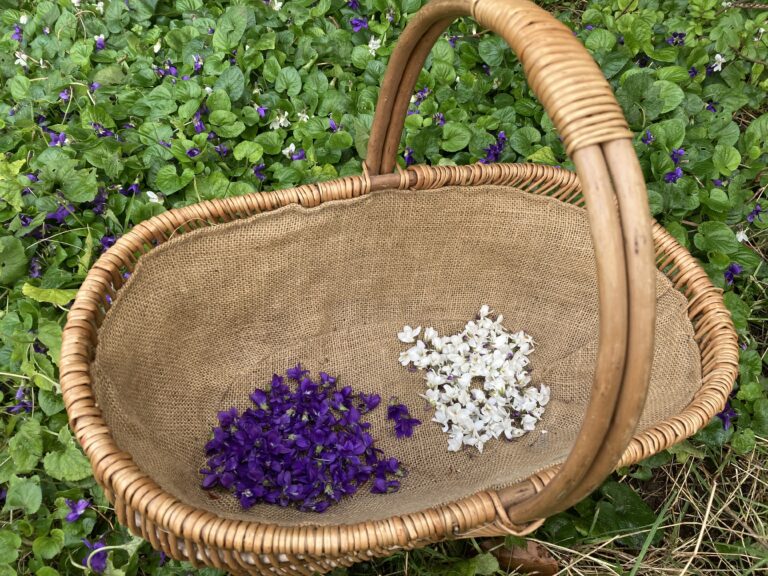
If you grow your own violets, or would like to gather them from the wild, do so in early spring, when the flowers first appear. The leaves are more fragrant if gathered just before flowering. You can use all parts of the plant (flowers, stems, leaves) fresh or dry, though typically it is the flowers that are dried for keeping, they shrink considerably in the process. Alternatively, you can open freeze leaves and flowers for future use. Both the smell and colour will fade over time (within a year), to delay this, store in a cool dark place.
In general, leaves and flowers may be used interchangeably, however leaves are better suited to poultices and flowers for syrups. Culpeper suggested different benefits for the purple and white flowers – purple to help quinsy and falling sickness in children; white to ripen and dissolve swellings.
I am always curious to identify the water soluble and oil soluble properties of plants. When gathering some violet flowers to decorate spring cocktails, I floated them in a shallow bowl of water to keep fresh until the drinks were made. Festivities over, I went to pour away the water from the shallow bowl and happily found it delightfully fragranced. As a comparison, I steeped some violet leaves and flowers in oil to see if the scent would transfer that way too (drying both for a few days before putting them in separate jars and covering with oil). My experimenting did produce a highly fragrant oil, with the flowers more pungent than the leaves, especially the white flowers – however, it wasn’t a scent I particularly liked. The scented water was much more pleasant. This year I will try a violet distillation to create hydrosol, a more intense water-based extract.
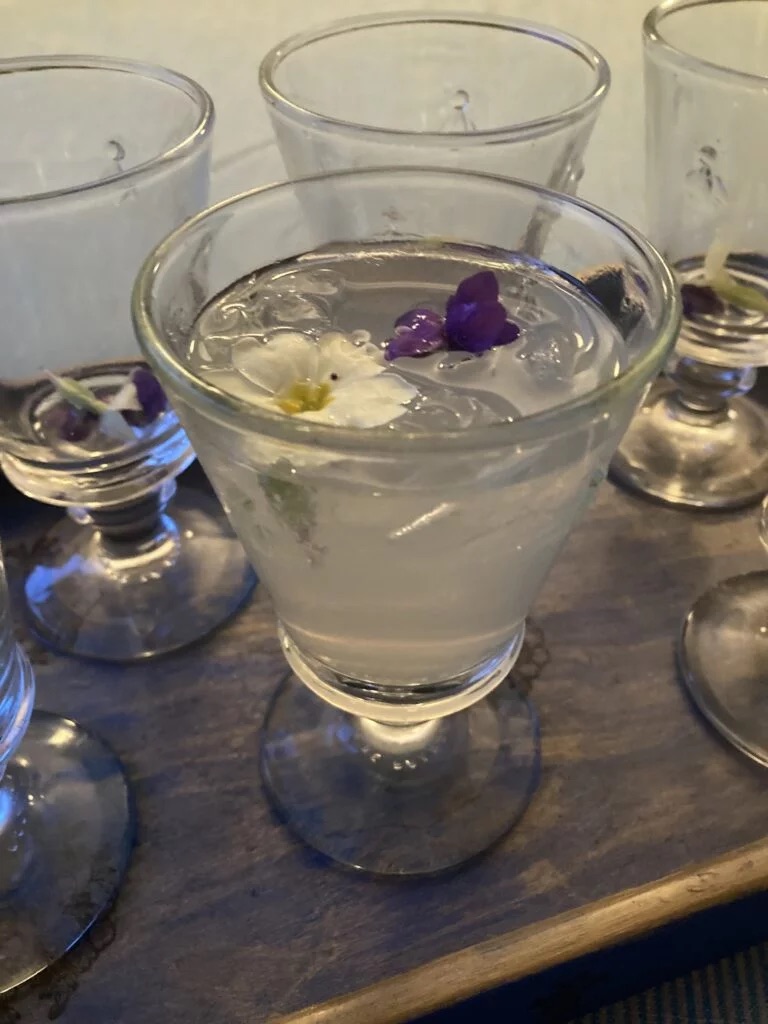
3 parts gin, to 2 parts lime cordial and 1 part freshly squeezed lime juice. Top with sparkling spring water and decorate with spring flowers.
Scent-sational
If it is the scent you’d like to benefit from, be aware that violet essential oil is rare, and expensive because it requires such an enormous quantity of flowers. It is a prized perfume ingredient, some of the largest violet plantations are at Nice, traditionally supplying the perfumiers of that region. When you do find violet essential for sale, it is often adulterated. More commonly the violet scent is created for perfumes synthetically. The leaves hold some fragrance, especially if picked just before flowering.
Constituents
The dominant constituent of violets is ionone, a ketone; this gives it the distinctive fragrance. It also has a soporific effect on our sense of smell. You may have noticed that you stop smelling violets after a while – it’s not the smell that’s gone, but our sense of smell that’s exhausted. Step away from them for a while and the smell will be there on your return. The consequence of not being able to be totally intoxicated by the scent is thought to be one of the charms of violets.
In addition, violets are rich in vitamins A and C, gram-for-gram, their vitamin A content is greater than spinach, and vitamin C content greater than oranges. They are also high in mucilage which creates the key therapeutic benefits of being cooling, soothing and moistening.
Traditionally violets have been used to counter inflammation, rashes, and eczema or other skin conditions. They are also considered to keep lymph moving so are associated with treating swollen lymph nodes, along with sore throats and coughs, helped by their demulcent quality. They are recommended for helping fibrocystic breasts and have been studied for their anti-cancer benefits, particularly in relation to oral cancers. There is good rutin content which James Duke (‘The Green Pharmacy’) attributes to their application for varicose veins.
Ever-helpful friend
The broad application of violets may in part be due to them being considered ‘safe’. Culpeper considers them ‘of a mild nature, no way harmful’. Hence being given to children, as well as adults. However, there is one caution, they can also act as a laxative so should only ever be taken in moderation.
As such versatile allies, I can recommend adding violets to your stores. As with so many things, the window nature provides for gathering is fairly small, one moment they’re plentiful, the next they’re gone. When you are able, gather what you can (always leaving more behind) and either store in their natural form for later use, or make your preparations of powers, syrups and balms to be ready at hand.
Here are some suggestions of where you may find violets helpful:
- For a feverish cold, take a violet decoction: infuse a teaspoon of crushed or powdered flowers in a cup of water for 10 minutes. Drink warm or cold, can be sweetened with honey.
- For a chesty cold or cough: take syrup of violets [recipe below].
Syrup of Violets is a classic medicine, historically made in Warwickshire where violets were cultivated for the purpose. Living in Warwickshire, Shakespeare would have been very familiar with the flower, perhaps accounting for the eighteen different references to it across his work. Here they appear in Cymbeline:
.. as gentle
As zephyrs, blowing below the violet,
Not wagging his sweet head.
Cymbeline, Shakespeare
Syrup of violets
Place a cup of violet flowers into a pan, and cover with a cup and a half of freshly boiled water. Cover tightly and infuse for 24 hours.
Strain off through a double muslin or coffee paper and add double the liquid’s weight of honey or sugar. Simmer in a heavy bottomed pan until syrupy.
At this stage, if you choose, you can add 2 tbsps of lemon juice and watch the blue liquid go violet.
Pour into sterilized jars and cover with wax paper lids (don’t let it touch metal lids).
This will last for several months in the fridge.
- To ease the pain of bruises and swollen joints: use a violet leaf poultice.
Violet Poultice
Gather leaves, wash and reduce to a pulp by mashing or using a blender. Spread this on a muslin or cheesecloth and heat by placing between two plates over a pan of boiling water. When hot, place over the affected area and cover with a dry cloth. Leave in place until relief is felt. Renew the poultice as necessary.
- To reduce swellings, including lymph nodes: use violet ointment or balm.
Violet Balm
Make this by blending oil macerated with violets with a little beeswax, or plant-based wax of your choice (try a ratio of 1:3 wax:oil). The maceration can be achieved quickly using the heat method (warming flowers and oil together for an hour or two using a double-boiler) or the cool method (steeping the flowers in oil and leaving on a windowsill for four to six weeks, shaking gently each day). If you have the patience, the cool method is always preferable for delicate ingredients like flowers. I’ll report back on after my experiments on whether I’d recommend substituting the normal windowsill for somewhere darker. There are many possible plant seed oils to choose from, sunflower, rapeseed or olive being some of the most accessible.
- For a headache: Make a tea using fresh or dried flowers, either drink this tea or soak a cloth in it and apply it to the back of your neck, sit back and relax for 10-15 minutes.
- Alternatively, use the traditional approach of binding slightly crushed violet leaves to the forehead and temples with an old scarf (but be careful, the juice from the leaves is very staining).
Even further back in time, Pliny recommended a garland or chaplet of violets worn about the head to dispel the fumes of wine and prevent headache and dizziness, so remember that for your next revelries.
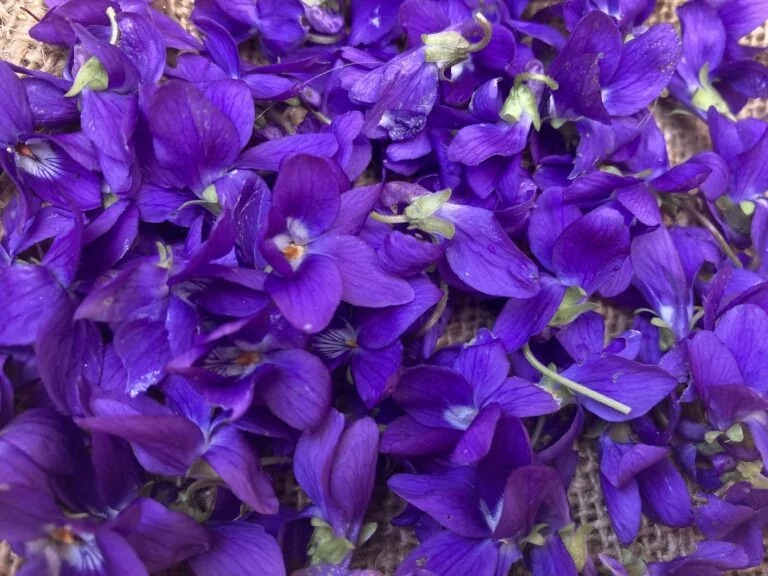
Vibrant violets
There are so many other ways that violets can bring seasonal enjoyment. Whether simply lying among them, (as Shakespeare must have done to be inspired to write: ‘I know a bank whereon the wild thyme blows, Where oxslips and the nodding violet grows’), using them in the kitchen – in violet jam, violet syrup, ice cream, vinaigrette, scattered into salads, fresh fruit salads and drinks, or sauteed or steamed, made into tea, encased in an ice cube for pretty drinks or crystalised as sugar decorations – or gathered as a fragrant posie, garland or for creative inspiration. Do make the most of these purply jewel-like gifts, again, Gerard had it right when he said:
‘the minde conceiveth a certaine pleasure and recreation by smelling and handling of these most odoriferous flowers’ and ‘the recreation of the minde which is taken here by, cannot be but verie good and honest: for they admonish and stir up a man to that which is comely and honest’
John Gerard