
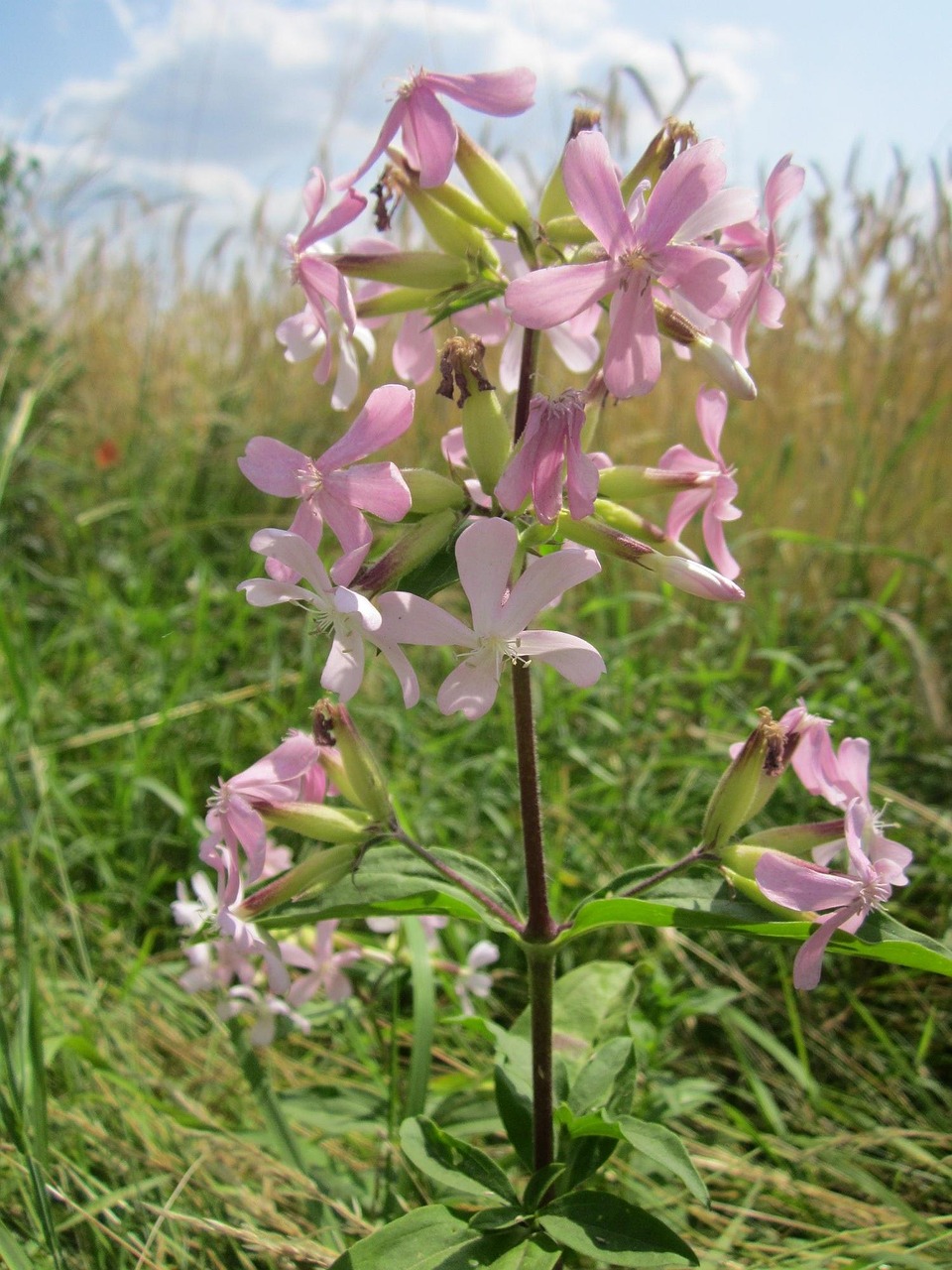
Saponaria officinalis
At the close of the year, energies are drawn inwards towards the earth. For herbs, this means directing resources to their roots, storing nutrients to fortify through the dormant season and ensure energy for new growth in Spring. For herbalists, this means Autumn is the time to carefully harvest roots, when they are at their plumpest, sweetest and most vital.
Herbs valued for their roots often have medicinal applications, they include dandelion, marshmallow and elecampane. Many other root crops are important food sources including the potatoes, carrots, turnips and swede that are staples of our winter diet. A number of different roots are utilised as substitutes for coffee, some of the most popular being dandelion and chicory. Soapwort roots have a different and unusual application, as her name suggests, they are used for cleaning.
Soapwort
As anyone who joins our herb walks will know, we love finding herbs that have a common name ending in ‘wort’. ‘Wort’ is shorthand for a ‘purposeful plant’, it indicates that the plant has commonly been recognised as useful in some way. Often the term preceding ‘wort’ in the name gives us an indication of what the use may have been. Soapwort is pretty straightforward, it was a natural plant to go to for cleaning.
Soapwort’s cleaning properties come from her saponins. Saponins are soap-like compounds, unusual in having both negative and positive charge (or polar, and non-polar properties). This duality gives them the ability produce a froth when agitated with water. This can cleanse as it is able to combine with both oil and water, therefore lifting dirt and grime, often held within oil particles, and also washing it away to effect cleaning.
Many plants contain saponins to some degree. In soapwort saponins make up about 4% of her dry weight, but they are remarkable in their variety. Estimates suggest between 40 and 70 different saponin compounds in soapwort extract. The highest concentration of these is in her root or rhizome.
Saponaria
As reinforcement of soapwort’s utility as a cleanser, her Latin name Saponaria derives from the Latin sapo meaning ‘soap’. Her full name is Saponaria officinalis, the officinalis part denotes inclusion of the herb in the official Materia Medica, i.e., the compendium of plants with known medical uses. Saponins are useful compounds to include in a variety of medical contexts and it is soapwort’s saponin content that is most responsible for her effectiveness in medicinal applications.
Saponins
Saponins are an active portion of many medicinal or pharmaceutical products. Taken internally they can support as an expectorant, alterative, laxative and purgative, as well as being particularly useful to help reduce cholesterol. Used externally saponins can help treat psoriasis, eczema and boils or acne as well as relieving gout and rheumatism.
Textiles
It’s when soapwort is used to clean textiles that she takes on what can seem like magical properties. Even delicate, old and disintegrating fabrics can be cleaned with a concoction of soapwort – as Lady Meade Fetherstonhaugh discovered when she took on the custodianship of Uppark Park and found herself with massive windows draped in Italian silk well beyond its best. The discovery which not only cleaned her curtains but also launched a trans-Atlantic enterprise was detailed in this blog as part of The Herb Society’s celebration of International Women’s Month.

If you have fabric to clean, do try with soapwort, I can attest that it is successful even on well-loved and extremely delicate teddy bears. However, don’t use soapwort in the washing machine (as you might ivy leaves), instead follow the instructions below.
If you don’t have fabric to clean, you might still find soapwort useful to use for cleaning the greenhouse.
To clean delicate fabrics using soapwort:
Fill a saucepan with leaves and crushed stems. Add enough boiling water to just cover. Simmer for 15 minutes, then sieve. A foam will form easily on the surface. Once cooled, use this liquid soap to carefully cleanse textiles.
The root can be boiled again several times to provide more liquid soap. Whisking the liquid creates lots of lovely, white soapy foam which can be dabbed onto fabric to clean.
Soap plants
While soapwort is our go-to native, temperate-growing, high-saponin plant, there are a few other local plants that make useful cleansers thanks to their saponin load, including horse chestnut seed, known better as conkers (Aesculus hippocastanum), the roots of Baby’s Breath (Gypsophila paniculata), leaves of our common ivy (Hedera helix), foliage and flowers of clematis (Clematis species) and rhizomes or roots of bracken fern (Pteridium aquilinum).
There are plants in other climatic regions around the globe which have a long tradition of being used as soap. These include soap nuts, also known as soap berries (Sapindus species), soap weed yucca (Yucca glauca and Mojave yucca), Californian soaproot, also known as amole (Chlorogalum pomeridianum), and soap bark tree (Quillaja Saponaria).
Sudsy discovery
When we talk about some of the uses herbs have been put to over the years, particularly medically, we’re often asked ‘how on earth did people find out about that property?’. With soapwort the means of discovery is a little easier to imagine. Soapwort prefers damp, sandy soil so will often be found near water courses. It would have been natural when stooping to wash in a stream to take hold of a nearby leaf to help scrub. It may have been surprising to find this produced a froth, and pleasing to see the clean result. You’d certainly look out for a similar leaf next time, and tell your friends about it. Do give this a try if you come across soapwort.
While the leaves are as handy as a wet wipe when out in the wild, for serious cleaning power, our ancestors learnt how to work with the even greater cleaning power of her root.
Root decoction
The woodier, harder nature of roots means it requires more effort to extract their compounds. Herbalists typically do this through decoction, which means boiling the root for in water. For best results the root should be chopped small and crushed. It’s wise to do the chopping as soon as the root is harvested and clean, once it’s dried it becomes hard and much more difficult to chop up. Keep turning the chopped roots as they dry to prevent mould forming. Store dried, chopped root ready to use whenever needed.
Recognising soapwort
Soapwort is an attractive looking plant. Growing to about two or three feet high she has smooth green leaves and in mid to late summer bears large pink flowers. Though individual flowers are not long lasting (especially when cut) they do have a pleasant, clove-like scent and are attractive to butterflies. Soapwort can spread when conditions are favourable, sometimes becoming invasive, so you’re likely to find her in large patches not isolated stems.