
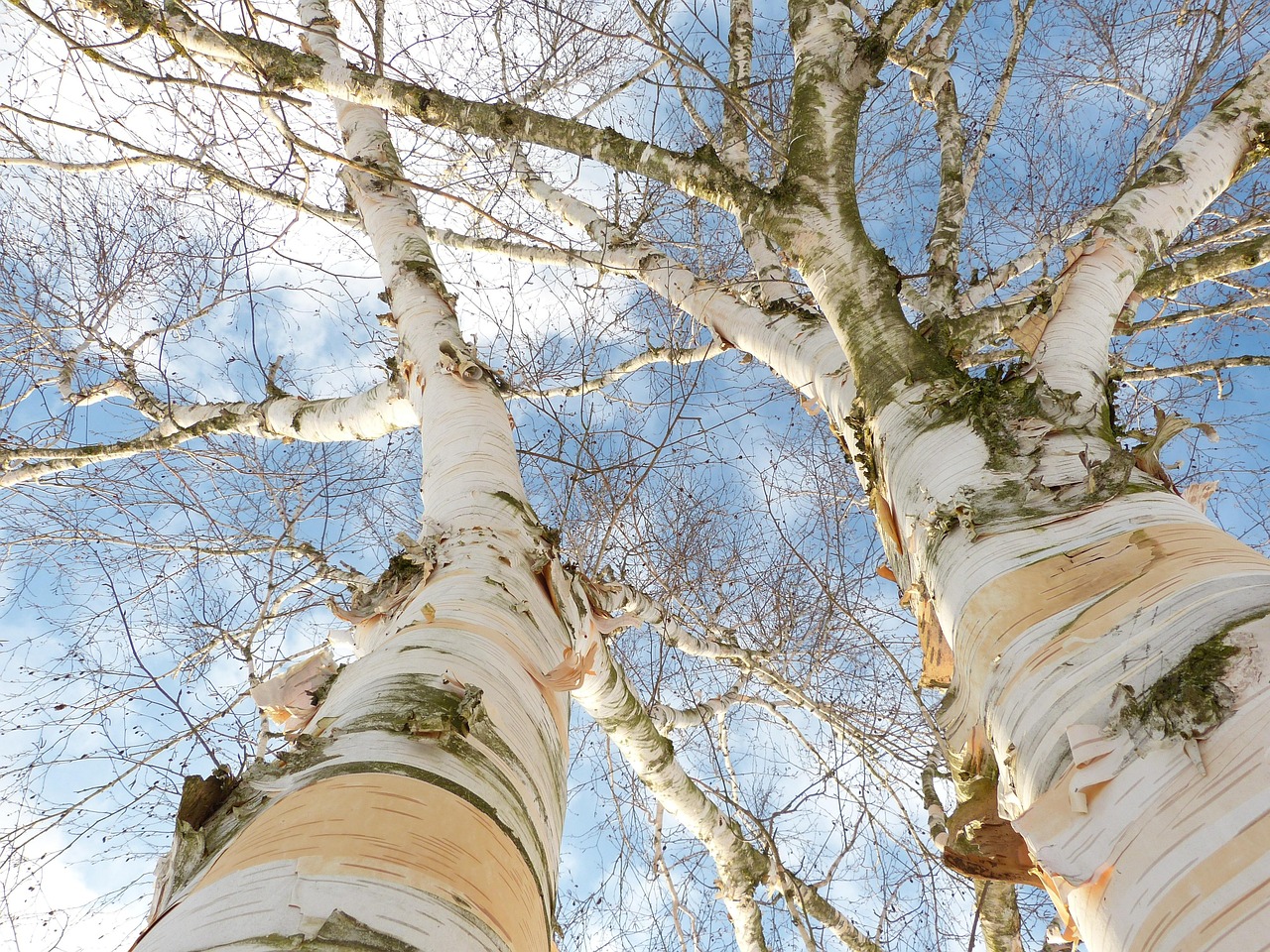
Ground never remains bare for long, nature will soon move in. One of the first trees to establish itself is often birch. Young birch trees will grow quickly and provide the shelter that enables the rest of the habitat to develop.
This is one of the reasons birch has traditionally been associated with new beginnings. At the start of the Celtic year, birch twigs are used in the Sahaim celebrations to drive out the spirits of the old year (a custom which has transformed into the Christian beating of parish bounds). Gardeners may also use a birch broom to sweep and ‘purify’ their garden. Birch is the first tree in the Ogham (Celtic tree alphabet) and most probably the first tree to take hold after the glaciers retreated at the end of the last Ice Age.
Content in winter
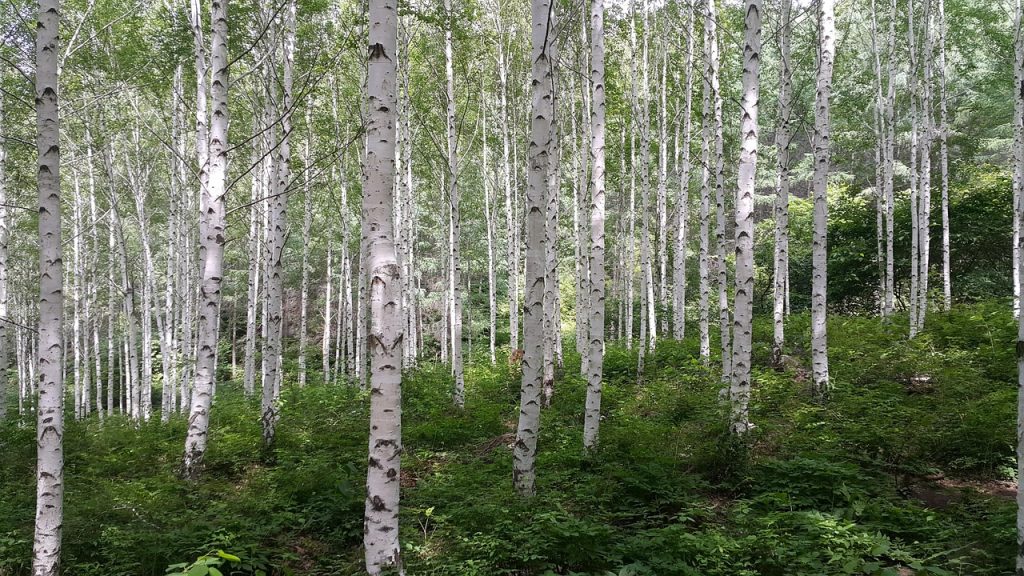
Birch is a tree of cold places, in fact the only native broadleaf of both Iceland and Greenland. There are 36 different species spread across northerly latitudes, all with distinctive barks. Our most common birch is Betula pendula, often called silver birch, white birch or European birch. It is admired for its chalky white bark, that shines in moonlight. A beautiful sight in this season of long nights.
The story in her name
The latin name ‘Betula’ is thought to derive from Ancient Sanskrit (an indicator of how long we have lived alongside these trees and benefitted from them). Their word bhurga means ‘a tree whose bark is for writing on’. Referencing the papery bark that peels from their trucks looking incredibly fragile, but in reality extremely strong.
It’s also possible the name is associated with Anglo Saxon beorgan which means ‘to protect or shelter’ as birch, and particularly that strong bark, was used for boat building and creating roofs.
The common name birch has Proto-Indo-European origins being traced to the word bherea which means ‘to shine bright white’.
Beautiful birch
Plenty of poets have admired the grace of the birch tree. She stands out among her woodland peers, perhaps because she often prefers a forest-edge position, but mainly because she has an elegance and fragility that sets her apart.
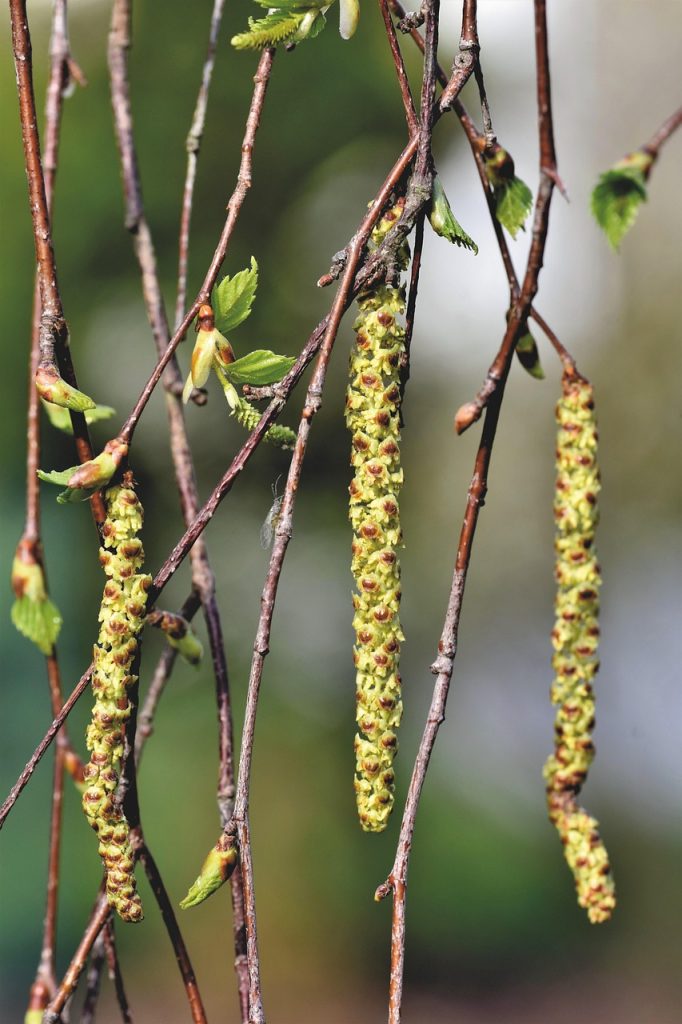
This is particularly so in Spring when the weight of her catkins causes slender boughs to bend. Both male and female catkins appear on the same tree, the male much longer than the roundish female catkins.
Coleridge was enchanted by birch referring to her as ‘The Lady of the Woods’; Tennyson is credited with popularising the suffix ‘silver’ to her name; but it was Frost who has provided us with the greatest elegy to birch, a 60 line poem about swinging within their branches.
Birch is also romantically considered ‘Mother of the Forest’ (a counter to oak’s status as father). This acknowledges the propensity birch has to nourish all around her, disseminating goodness through her roots.
Birch’s many uses
birch twigs
Birch twigs are notoriously fragile, breaking in the slightest wind. They are collected and put to use in many ways, often as a besum brush (beloved of witches), also as thatch and wattle or there are some uses in cloth making. When heather or bracken is short in supply, plentiful birch twigs may be used as bedding. They are also the chosen whipping tool in saunas, associating them with cleansing and rebirth.
Early in the year, twigs can be gathered while still in bud then infused for a while in hot water to produce a household cleanser excellent for loosening grease and grime. The same twigs can be boiled up to 30 times, keep adding new supplies of boiling water as needed – they will keep going for the whole spring clean.
birch wood
Her branches provide fuel, popularly used in Scotland when distilling whisky or smoking hams and herrings; and they were also burnt to make the charcoal favoured for creating gunpowder.
Birch wood is soft and not very durable so tended to be used for making small items, like bobbins, spools and reels, broom handles, toys and cradles. It’s lightness (in weight and colour) have favoured it for making electric guitars, and veneers.
birch bark
In contrast to the fragility of birch twigs and weakness of birch wood, birch bark was prized for its durability. Testament to this is the intact bark at least 100 years old that has been found in peat bogs.
This strong material, naturally impregnated with protective oil, has been put to many uses within different cultures. For example, it is favoured by Native Americans for building canoes; the Sami will make cloaks and leggings from it; the Norwegians use it for roofing; and in Russia leather is tanned using birch bark creating a distinctive musky scent and astonishing powers of endurance. The bark contains about 3% tannic acid. It is said that a book bound with Russian leather will not succumb to mildew. It is also a useful alternative to oiled paper wraps, preserving and protecting the contents.
The use of birch bark as a writing material pre-dates paper, and most likely inspired the art of papermaking. Magic spells are potent when written on birch bark.
Birch bark will burn whether wet or dry, hugely useful in cold conditions. However, curiously, a simple birch bark cup can be used over an open fire to boil water without itself burning.
birch sap
Birch trees can be tapped to draw off the saccharine juice which is traditionally fermented with yeast (and added honey, cloves and lemon peel) to create birch beer, birch wine, spirit or vinegar. A Druid’s customary beverage to celebrate the spring.
Birch sap contains betulinic acid, an anti-cancer compound.
Be aware, however, that unlike maple, birch does not heal from the wound drilled to access the sap and can slowly ‘bleed’ to death.
birch tar oil
Birch bark can be distilled to yield an empyreumatic oil known as Birch Tar, Oleum Rusci, Oleum Betulinum or Dagge. This is a thick, bitumous, brownish black liquid with a pungent, balsamic odor, almost identical with wintergreen oil. Indeed, birch is sometimes used commercially to produce wintergreen essential oil. You can get an idea of this by smelling the birch twigs, they also have an aroma like wintergreen, particularly after rain.
Rubbing the oil on hands can be a deterrent to insects and gnat bites.
birch leaves
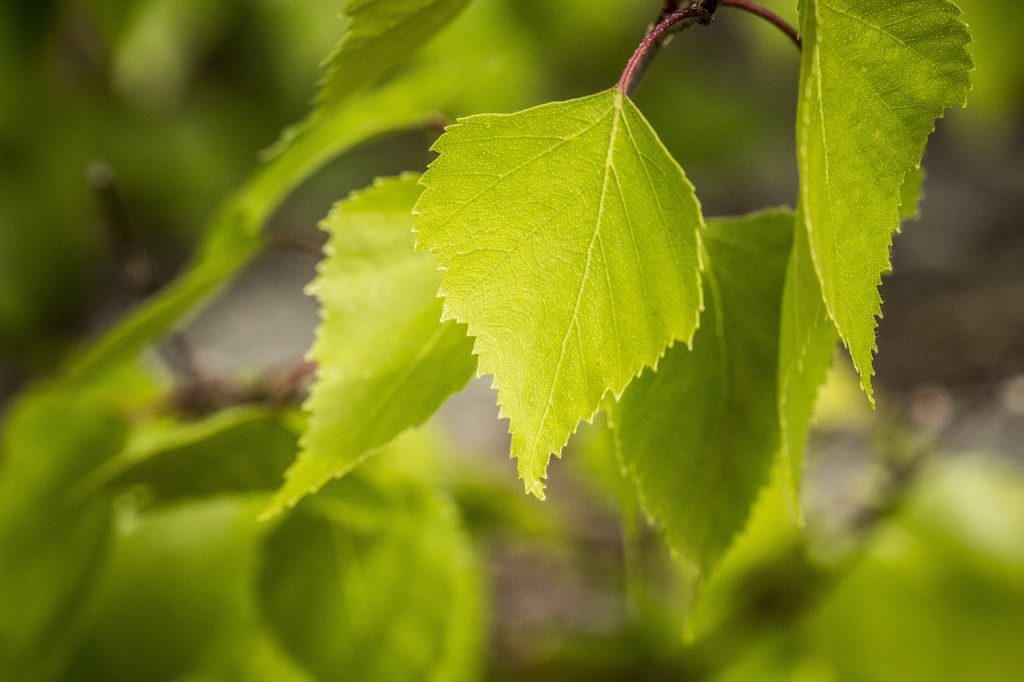
Leaves gathered in spring have different properties to mature leaves.
Spring leaf tea is recommended for sore throats, constipation, rheumatism, and bladder or urinary tract infections, including cystitis. It has a pleasant aroma and a bitter taste.
For a birch leaf tea bath, use the mature leaves and brew strong. This astringent brew is beneficial for the skin. Bark can also be added to the decoction. The leaves are anti-inflammatory, analgesic and antiseptic; the bark can help ease muscle pain.
Birch leaf oil (made by macerating leaves in oil) can be massaged onto sore muscles and used against skin conditions such as eczema.
Magical birch
The many mystical qualities of birch have led to magical associations and tales across many cultures.
Native Americans have a host of stories in which birch saves the day; the familiar European tale of Cinderella is based on a Russian story in which a woman becomes a tree in order to take care of her orphaned daughter. Folklore credits birch as a sacred goddess tree providing protection.
Birch is associated with fertility. In the Highlands of Scotland, an unbearing cow would be driven with a birch branch in the belief that this would make her fecund.
Harbinger of Spring
As one of the first trees to come into leaf, birch is worth looking out for in Spring. Especially as those drooping catkins add an eye-catching elegance.
O, and if you should happen to find yourself dreaming of birch, be prepared to begin a new aspect of your life, or otherwise find new spiritual understandings. Altogether rather beautiful.
Beneath you birch with silver bark
And boughs so pendulous and fair,
The brook falls scattered down the rock:
And all is mossy there.’
Samuel Taylor Coleridge
Leave a Reply