
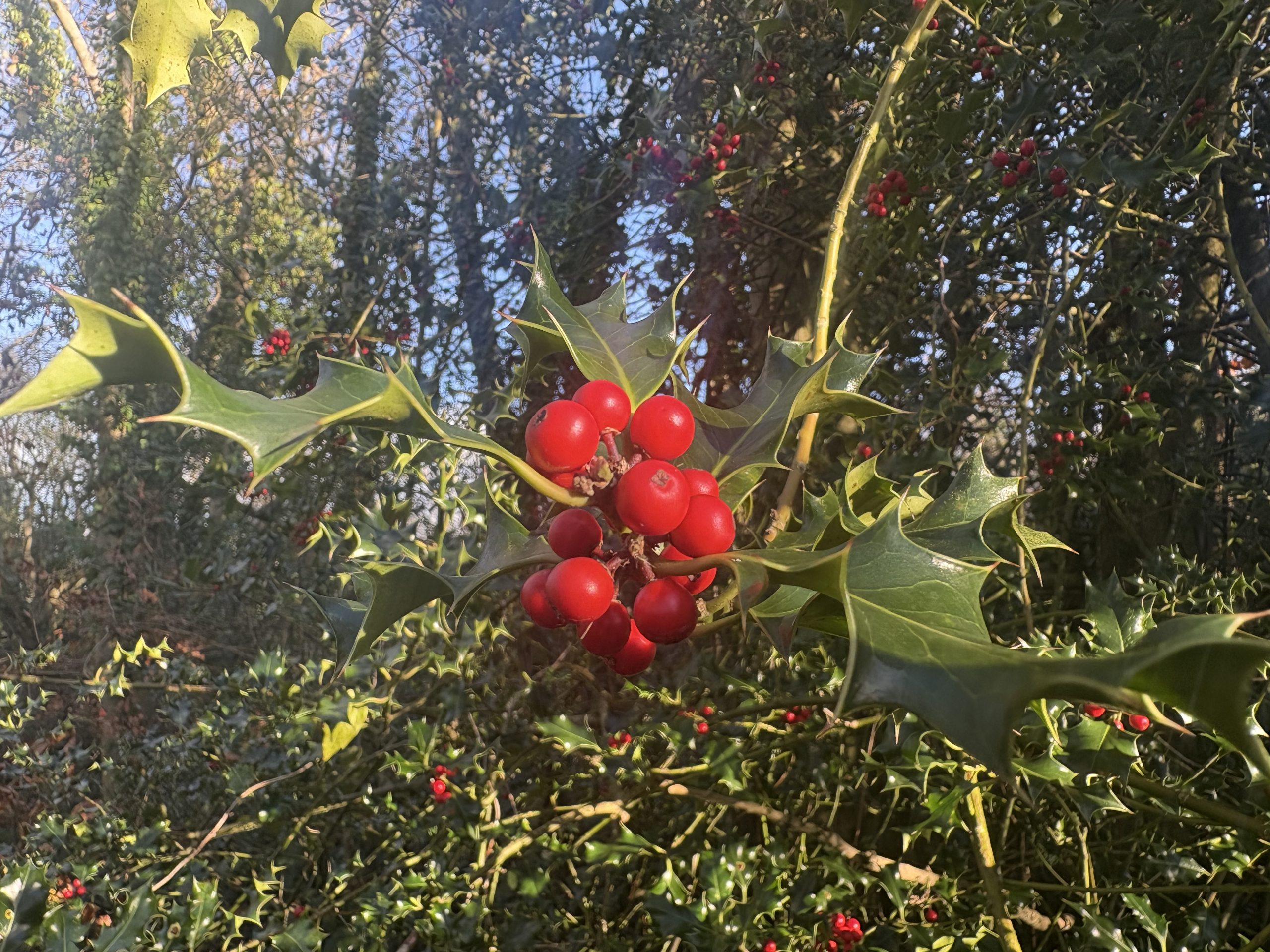
At this time of the year, our woods are full of sleeping giants. The dark, muscular trunks of beech stand in slumber, their leaves coating the ground with a russet uniform.
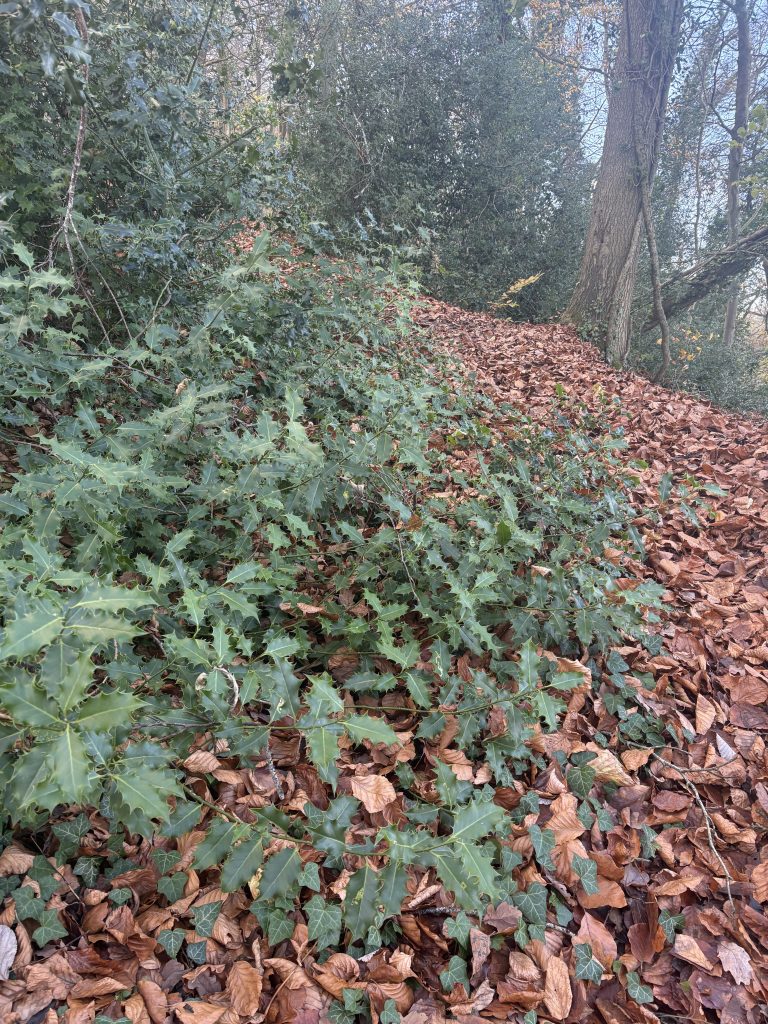
The green that gives us hope of life ongoing is holly, present on every corner, at every turn – evergreen. Despite her glossy spikiness she is easily overlooked, so ubiquitous she disappears. Unless her bright berries catch our attention.
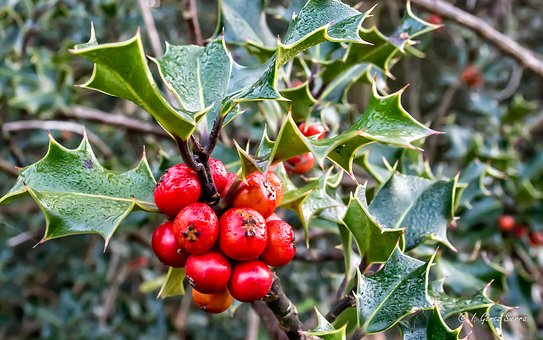
She has long been ‘King’ of Christmas.
Christmas Trees
Before Nordic Christmas trees were introduced in Victorian times, a reference to the ‘Christmas tree’ would mean the Holly. Some homes still prefer a holly branch to a Christmas tree.
The old association is evident at Christmas Common in the Chilterns, where holly trees grew in abundance, and in local names for holly including ‘prickly Christmas’ and ‘Christ’s thorn’. Medieval monks called it the Holy Tree.
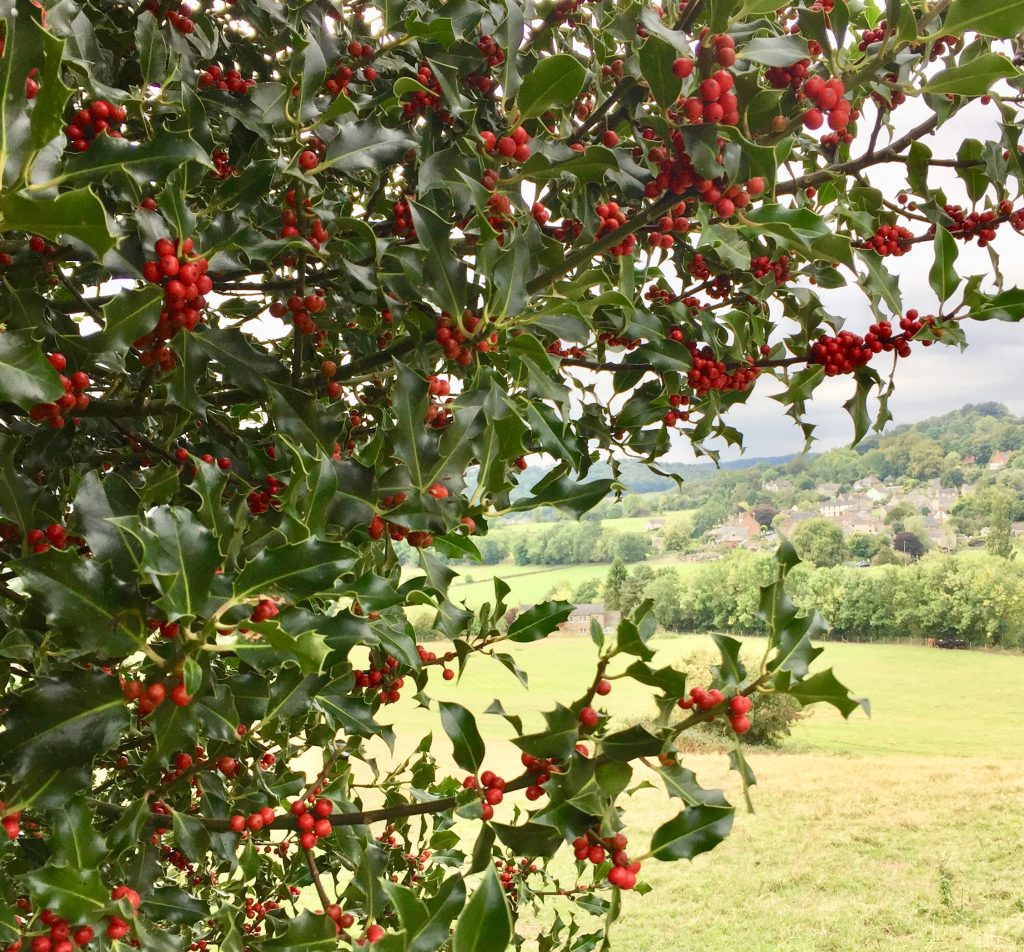
Longstanding luck
Holly is often left to grow, while other hedgerow plants are grubbed out. There are several suggestions as to why this is so.
The practical suggest that the evergreen tree provided line of sight for ploughmen.
Or possibly, it’s longevity is because it is not much troubled by insects; the thick, waxy leaves are so impenetrable it plays host to possibly the lowest diversity of mini-beasts of any hedgerow species.
The superstitious believe that when a holly goes, a witch appears in her place; or they fear illness, heartbreak or disaster precipitated by cutting down a holly. There’s also a tradition that holly is the ‘King’s’ tree and therefore not to be cut down, which perhaps explains the line in the carol ‘Of all the trees that are in the wood, the holly wears the crown’.
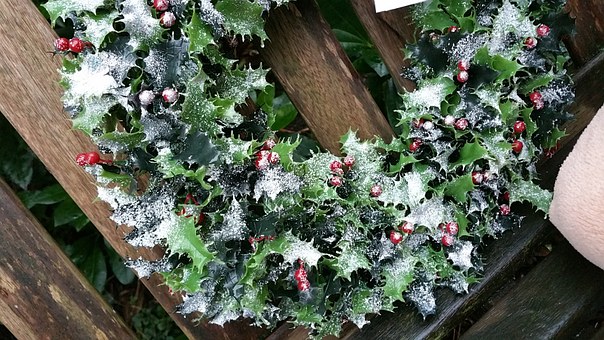
Deck the halls
Decorate with holly boughs, laden with berries, and elves or fairies may join your Christmas celebrations as they will have a holly branch to shelter under, and in return they’ll protect you from the house goblin. It is, however, unlucky to bring holly into the house before Christmas Eve.
Be careful how you bring holly indoors, and how you dispose of it afterwards, it seems there are many, sometimes contradictory, options:
- in Yorkshire, a holly leaf is placed in every room in the house
- in Lancashire, a holly leaf falling from a decoration should never be put on the fire
- in Hampshire, holly used in decorations should be burnt in the garden afterwards for continual good luck throughout the year
- in Shropshire, a sprig of holly from the Christmas decorations should be left until Shrove Tuesday when it could be taken down and put on the fire over which the first pancake is cooked
- in Scotland, boys are encouraged to thrash each other with holly as decorations are taken down: every drop of blood drawn added a year to their lives
- in Somerset, berried holly should only be brought indoors by a man; if berried holly is not available, include a sprig of box in your arrangement to counter the ill luck non-berried holly could bring.
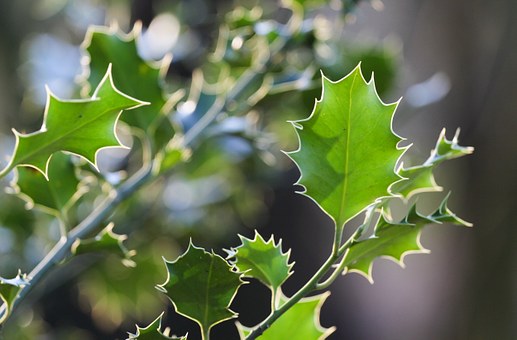
She-holly and He-holly
For decorating, the top most branches of a holly tree were prized and could command a higher price. Why? because above browsing height you could find less prickly leaves, known as ‘free’ or ‘slike’ holly. Holly does not need to prickle where she is not threatened (nature teaches us a lot).
This non-pricky holly was also sometimes called he-holly; in contrast to the prickly she-holly.
In Derbyshire it was said that if prickly holly was used in the Christmas decorations, the man would be master for the following year, but if non-prickly, the woman would reign.
You can also put a smooth-leaved holly under your pillow for the divination of dreams. In the language of flowers, holly stands for foresight and good wishes.
Nutritious fodder
Less prickle would be advantageous when holly is used as fodder. It has been winter food for sheep since ancient times as it has one of the highest calorific contents of all the trees animals browse and it is rich in nutrients too. Sometimes leaves were ground to make them more palatable.
Rudimentary shelter
Holly is known to provide shade in summer and shelter in winter (it takes a while for rain to penetrate the canopy). A true gypsy woman would always give birth under a holly tree, and cattle too will seek one to calve under. Which seems another appropriate connection at this time of year as we celebrate a special birth in rather rudimentary conditions.
Holy holly
The name holly may be a corruption of ‘holy’ suggesting a connection with the Christ Child, probably due to the adoption of holly as part of the Christmas celebrations borrowing from the Roman Saturnalia December festival of merrymaking.
Holly is also turned to at the other end of life, a sprig should be hung up high in a new building or in one where an animal has died in order to remove and keep away evil spirits. Remember to burn it when you take it down.
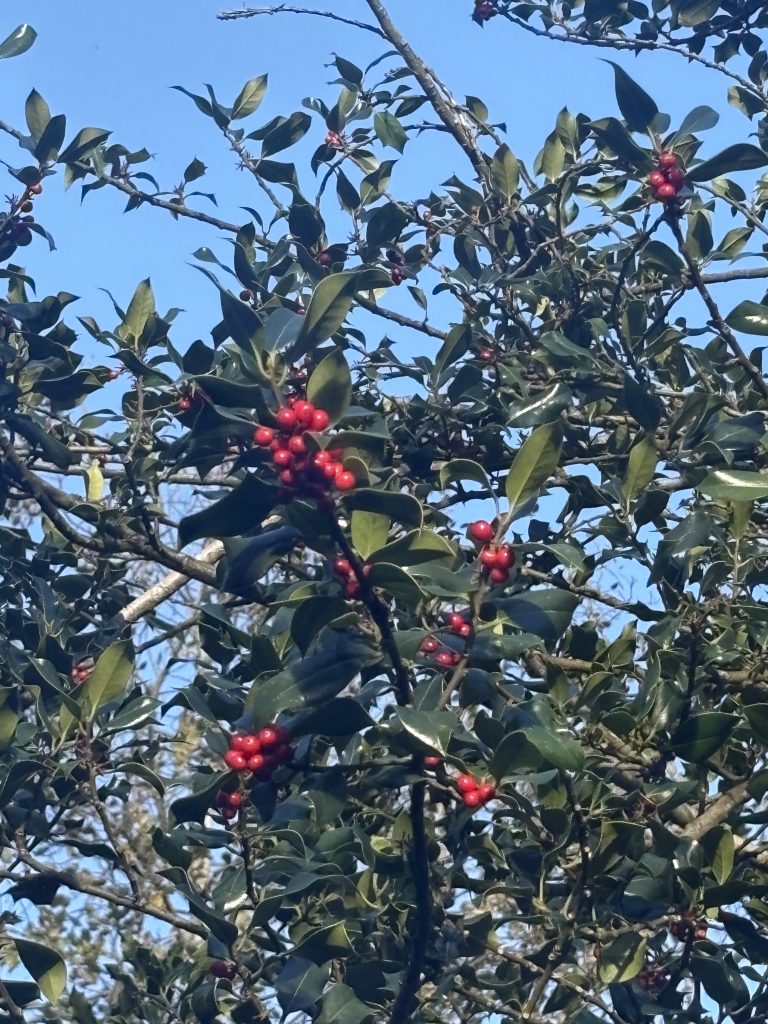
Holly for celebration
Among the alkaloids, saponins and flavonoids that holly contains is the compound theobromine. This is more familiarly turned to in cacao (chocolate’s latin name is Theobroma cacao’) which is a popular celebratory drink, bringing people together into deeper connection with each other, themselves and the spirit realm. Holly, like chocolate, is able to stimulate the central nervous system to bring feelings of euphoria and heightened awareness.
Traditional South American Yerba Mate ceremonies share a drink made from the leaves of Ilex paraguariensis, a relative of our holly, Ilex aquifolium.
Holly is a sacred tree in Norse mythology, representing goodwill, restored balance, unconditional love and peace. Happy Holly-days.
Leave a Reply to Festive Calm – Cotswold Herb Centre Cancel reply