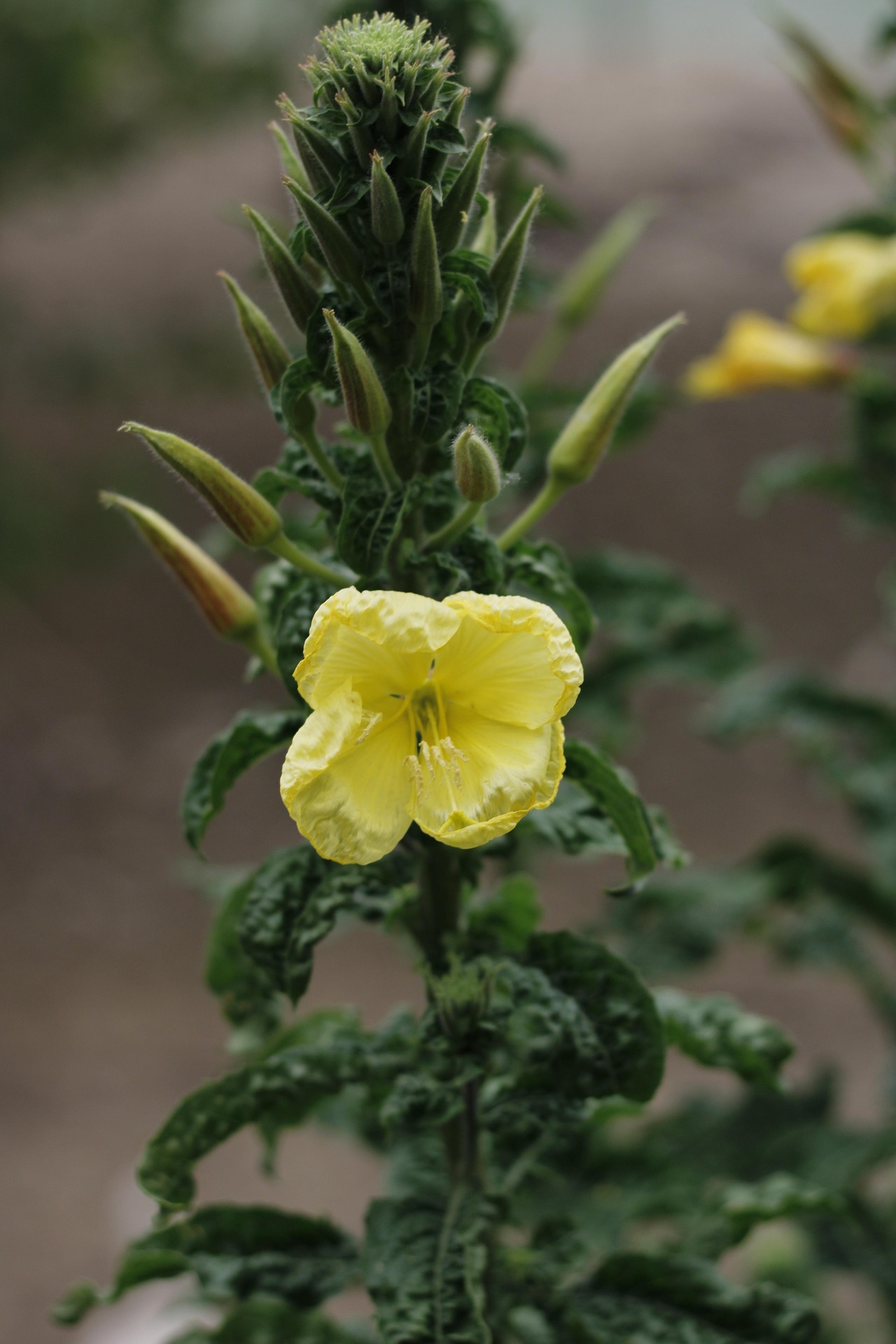
Herb of the Month for July: Evening Primrose, Oenothera biennis
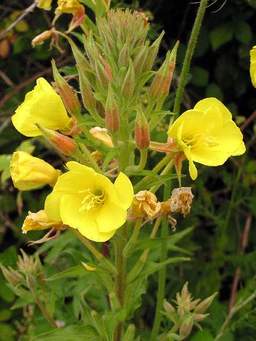
The herbal year starts with primrose (‘the first flower’) but as we progress through summer, those little ground-huggers are long gone and instead we find the tall spikes of evening primrose. The common name and yellow colour is all these two plants share.
A family of tall, flowery plants
Evening primrose is a member of the Oenothera family, making fuchsias and willowherbs her natural relatives. Fuchsias hang over many a garden fence, great willow herb can often be found along river and canal banks, while rosebay willow herb is a common site along roads and railways.
Ancient origins
Evening primrose’s origins have been traced back to Central America and Mexico 70,000 years ago where she would flourish even in desert conditions. Despite knock backs in multiple ice ages she successfully colonised North America and was aided in crossing the Atlantic initially by the plant hunter John Tradescant the younger in the late 17th Century but then en masse in the 18th Century when her seeds nestled within the earth used as ballast in the ships of the tea trade. Her flowers still grow along the coast near Liverpool!
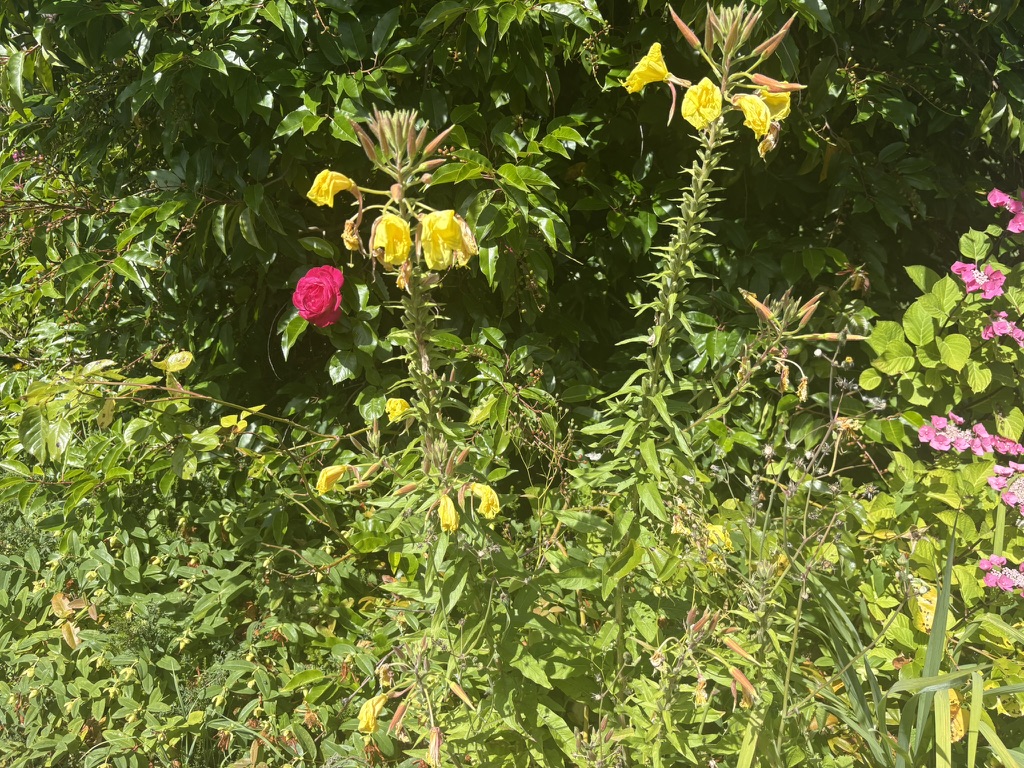
Evening primrose can be found along rivers and streams but more often in waste ground and roadside verges, with particular species adapted to coastal dunes. She will also appear where she chooses within gardens, manifesting as a tall, slightly ragged looking flower spike, from a basal rosette of leaves.
Succession of flowers
If you’re blessed by her presence, watch those flowers daily. Like her cousin, rosebay willow herb, evening primrose flowers in succession up her stem, blooming in turn, from base to top. Her flowers open in the evening, as her common name implies. A folk name is sun cups, referencing her cup-like yellow flowers, I can picture them holding the setting sun. Evening primrose’s glowing petals have a late-night luminosity that lures in various butterflies, hawkmoths and bees. Those she attracts are able to handle her viscous pollen strands.
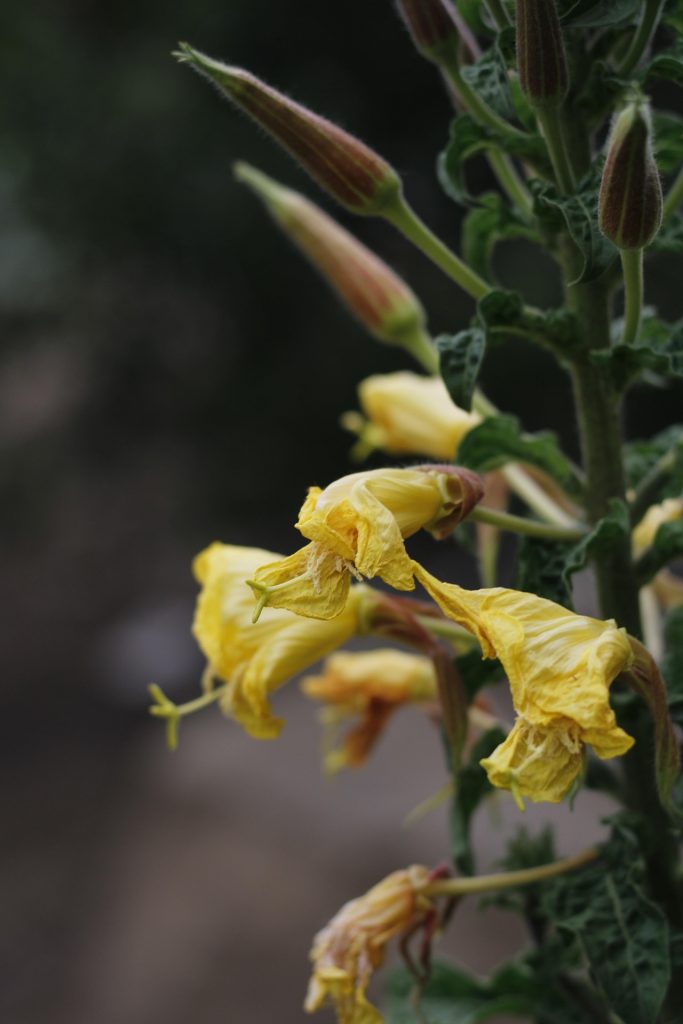
Flopping limply overnight, by dawn her droopy petals remind me of the sluggish mornings that follow late night partying.
In a connected thought, it is suggested that taking evening primrose oil before drinking can help prevent a hangover. Back in Ancient Greece Theophrastus, the physician, is said to have given her the name ‘Oinos’ (wine) and ‘thera’ (hunt) suggesting she was possibly used then as a hangover cure.
Comes and goes
Evening primrose gives the impression of coming and going because she’s a biennial, meaning she flowers every other year. Sometimes you may have many, other years few. If you want to encourage her, leave the spent flower heads on to form seeds; but if she’s getting too adventurous, snip the spent flowers off early, you may even get a second flush of blooms. Thankfully drought tolerant, evening primroses, once they’ve found their happy place, should keep going even through the super-sunny summers we’re now becoming accustomed to.
Evening primrose oil
Evening primrose is mostly cultivated for her seeds which, when pressed, release a seed oil that is high in gamma linoleic acid (GLA), at around 9%. Its presence was first discovered through analysis in 1919. This omega 6 fatty acid, helpful for improving skin moisture, is not normally made by humans, but it is found in human breast milk, which protects and nourishes the immune system, leading to curiosity about the possible benefits of breastfeeding to mitigate childhood eczema.
This is because the most verifiable benefit of evening primrose oil is to provide relief from eczema when the oil is used topically1. It is also used topically against acne because it helps soften skin and is also easily absorbed without oily residue. However, there is a strong heritage of evening primrose oil being promoted for use in managing symptoms of PMS such as breast tenderness and bloating, lessening the hot flushes associated with menopause and supporting through heart and vascular diseases. Typically the oil is taken in capsule form to address these.
The blend of fatty acids in EPO includes linoleic acid (at high percentages of between 65% and 85%), GLA, oleic, palmitic and stearic acids, at proportions that align well with human sebum, making it a good skincare oil. As well as increasing moisture, preventing skin drying, EPO can help increase skin cells’ ability to absorb oxygen and withstand disease. The GLA content enables creation of prostaglandins, important for controlling intercellular functions and helping skin withstand UV.
Evening primrose seed oil (EPO)
The seed oil is pressed from her tiny seeds. The best sources are cold pressed but most is extracted using solvents such as hexane. It has a musty smell (like borage seed oil, which is also high in GLA), golden yellow colour, and a fine texture. The oil is expensive and also very vulnerable to heat, making it fragile to distribute and use. Therefore capsules are a sensible choice, they can be snipped open to release the oil if needed. A bottle of oil will be quicker to oxidise and ruin.
The seeds themselves are edible and can be scattered on breads, flapjacks and porridge as an alternative way to access their beneficial oils. When left on the plant to nourish the birds they are favoured by finches.
Cure all
A common name ‘Kings’ Cure’ dates to the 17th Century when evening primrose was believed to have powerful wide-ranging healing properties, reputedly being able to treat nearly any ailment or fever. It is no longer regarded such a magical cure. However, evening primrose does have a long history of medicinal use. Native Americans used evening primrose as a tea to treat bowel problems, brewed the seeds to heal wounds, and applied juice from the stem or poultices of leaves to treat skin inflammation and bruises or sprains. More generally the plant is used against muscular pain and boils. Teas might also be used to treat stomach aches, and juice from the roots to treat coughs. Culpeper, writing in 17th Century England suggested of evening primrose, ‘It opens obstructions of the liver and spleen, provokes urine, is good for the dropsy if infused in common drink’. In Chinese medicine and Ayurveda, evening primrose is used to stop itching (aligned with our most proven benefit for the oil which is against eczema) they also valued her antioxidant and anti-inflammatory properties. Modern herbalists might offer evening primrose leaves as a sedative, diuretic or mild disinfectant.
Good cheer
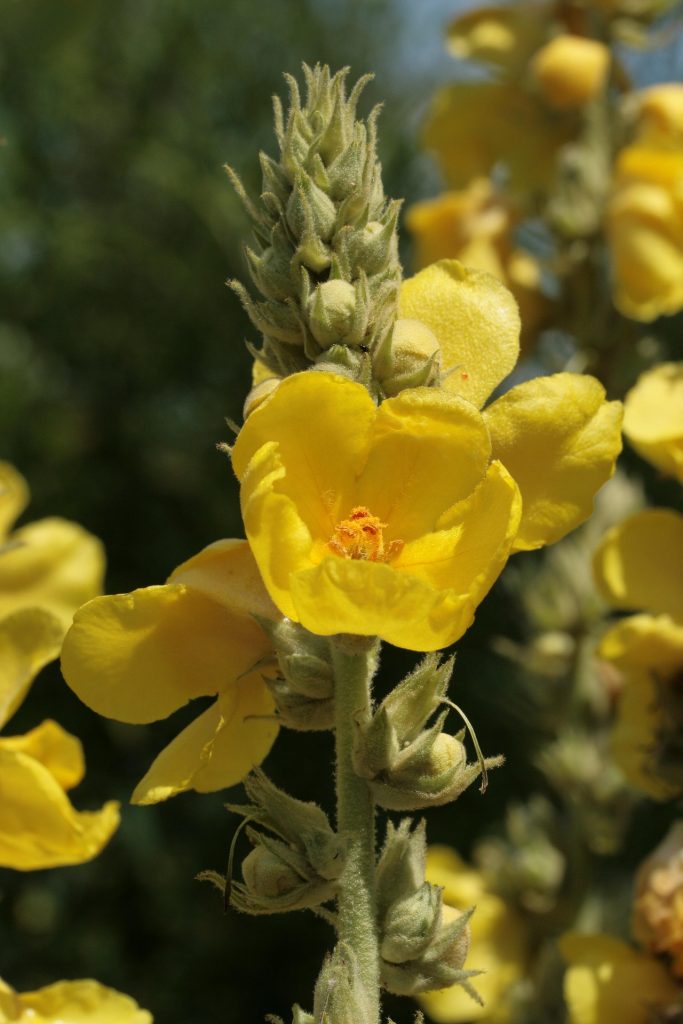
Similar to borage, evening primrose has a reputation for lightening the spirit. Pliny said of evening primrose ‘it is an herbe good as wine to make the heart merrie. Of such virtue is this herbe that if it be given to drink to the wildest beast that is, it will take the same and make it gentle.’
Reference
1. Schalin-Karrila M, Mattila L, Jansen CT, Uotila P. Evening primrose oil in the treatment of atopic eczema: effect on clinical status, plasma phospholipid fatty acids and circulating blood prostaglandins. Br J Dermatol. 1987 Jul;117(1):11-9. doi: 10.1111/j.1365-2133.1987.tb04085.x. PMID: 3307886.