Corylus avellana
There are various types of Corylus, all of which are edible. Corylus avellana is the Common Hazel, and the tree we will most commonly find in woodlands and hedgerows.
The ‘avellana‘ part of her name comes from the Italian province of Avellino where there is a village called Avella. Hazelnuts were the dried fruit of Avella.
Hazels, like elders, can sometimes appear more bush than tree. The tallest variety of hazel tree is an introduction from Turkey, Corylus colurna, sometimes called the ‘Constantinople Nut’. It was introduced to Britain in the 17th Century (about the same time as horse chestnuts) presumably because it was thought to be a good nut producer. However true that was in its native Turkish climate of cold winters and warm summers, it didn’t hold true here. These tall Turkish Hazel trees are now typically found in parks, planted as ornamental trees.
Don’t get confused with the witch hazel (Hamamelis), this comes from a different botanical family. The shared name came about when early European settlers in North America saw a plant with similar shaped leaves to the hazelnut. And the ‘witch’ or ‘wytch’ part of the name comes from an old English word wyce or wiche meaning pliable, or bendable.
Regenerative
They are often many-stemmed, a natural feature of the tree, but also encouraged in many instances through coppicing. Hazel is incredibly good at regenerating itself when cut back so was used to provide an endless supply of thin rods and poles.
Popular therefore for the woven fences known as hurdles, or for basket making (a rougher alternative to willow) and to make coracles. Traditionally also used in thatch and in wattle-and-daub for building homes. A forked twig of hazel was commonly used for dowsing to find water (known as ‘witching sticks’). Do you use hazel branches to support your beans or sweet peas? With so many uses, some call them the ‘Swiss Army knife’ of plants.
Roundness
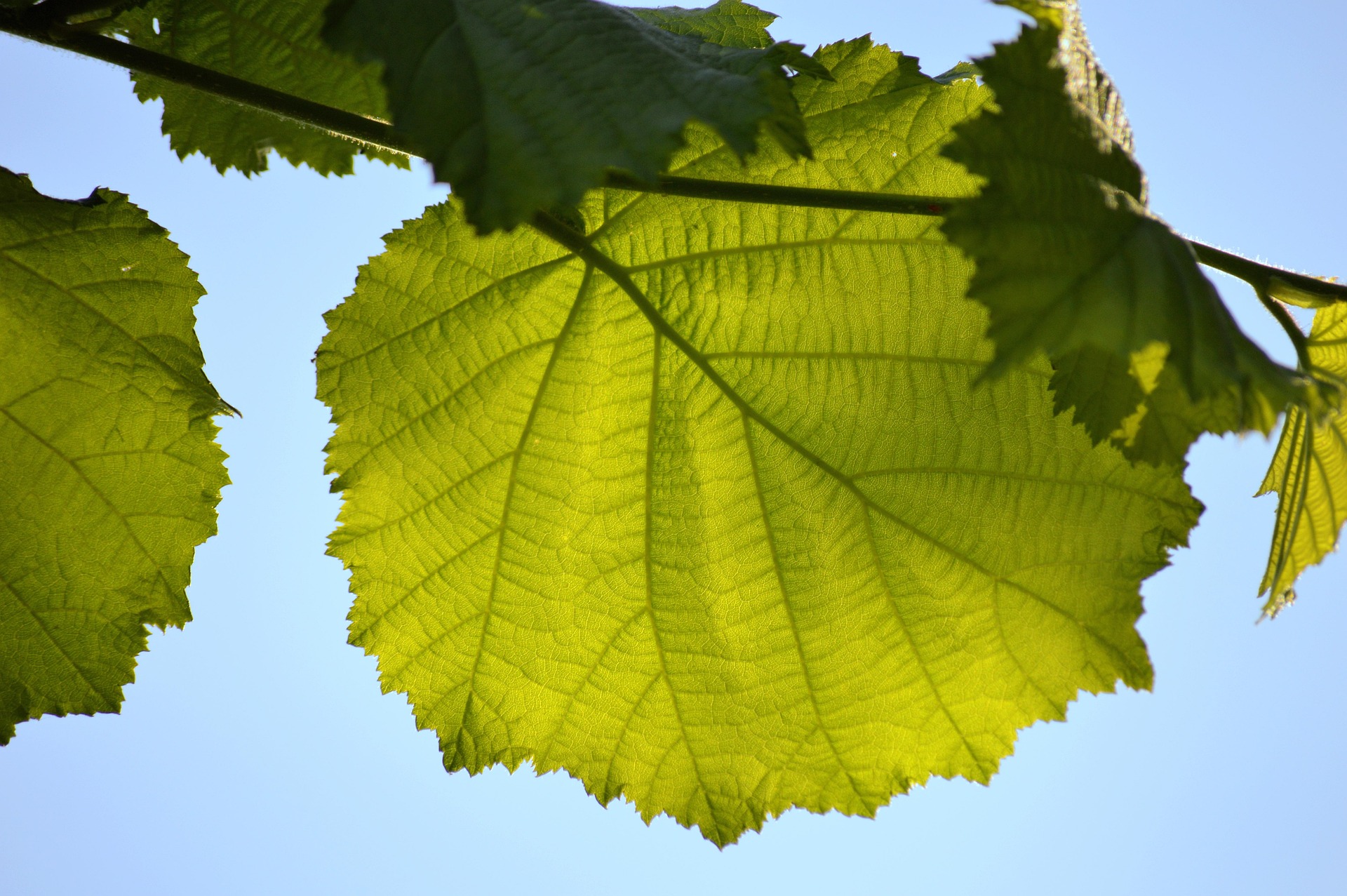
Hazel’s leaves are similarly round to her nuts, both broad at the base with a slight point at the top. With autumn approaching, they will be turning golden yellow before falling. Bare stems through winter will then show occasional clusters of small greyish catkins.
One of the loveliest signs of spring is when these expand and become drooping ‘lambs tails’ packed with golden yellow pollen. The association with new life is because they are rare in this habit of blooming and pollinating while it is still winter.
The yellow catkins are the male flowers, the female flowers are a much less conspicuous red flower at the tip of the branch.
Hazelnuts, Cobnuts and Filberts
Hazelnuts
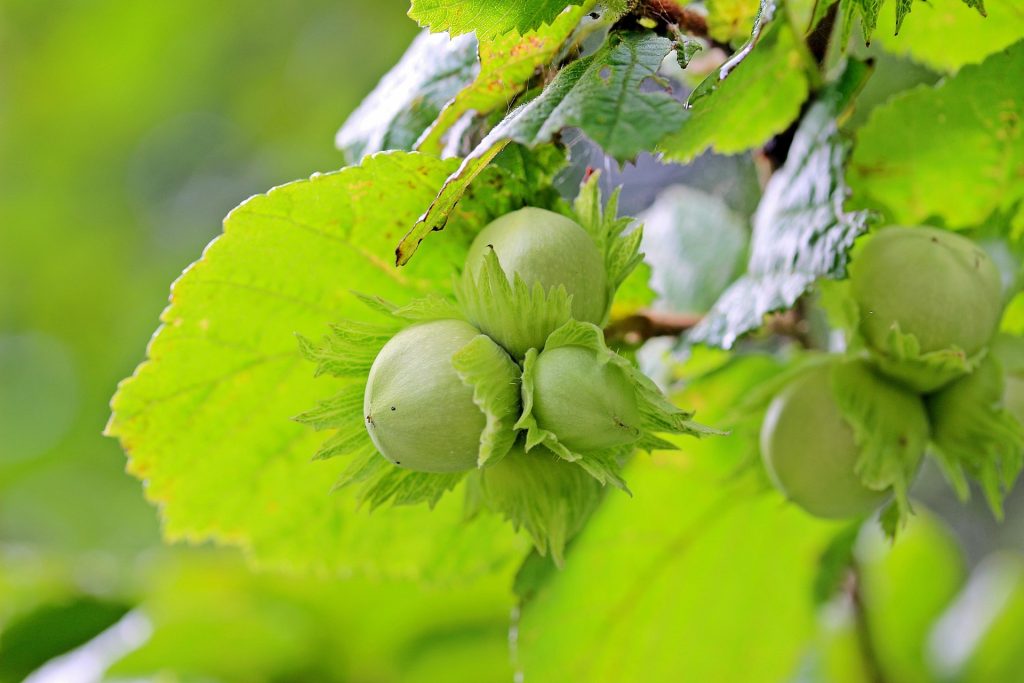
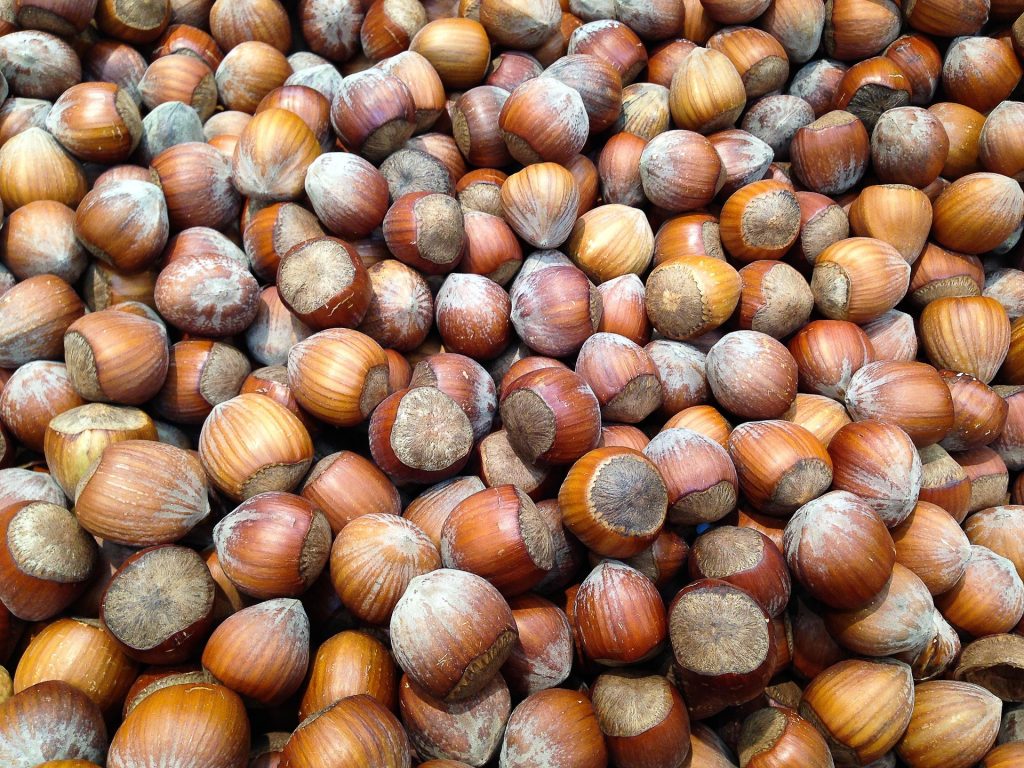
The small brown outers of hazelnuts contain sweet white flesh, beloved of squirrels, pheasants and pigeons but also one of the first nuts children are content to eat. Possibly a reason they’re included in chocolate bars.
The name hazelnut is likely to come from the Anglo Saxon haesel, which means bonnet or headdress, referencing the shape of the shell around the nut.
Cobnuts
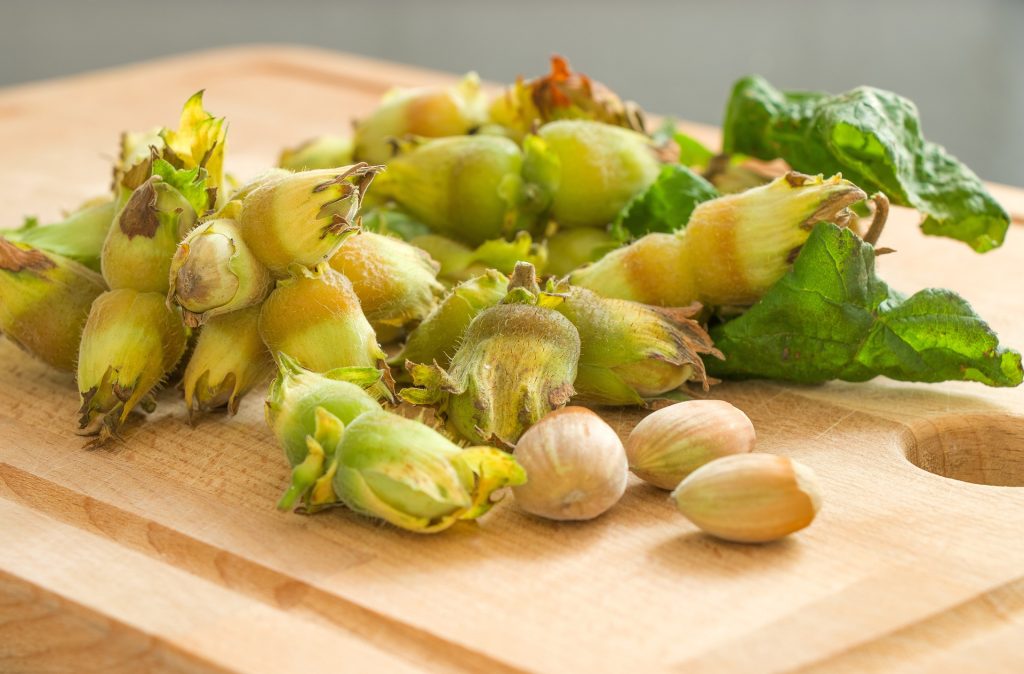
Cobnuts are a specially bred variety of hazelnut, selected particularly for their size. They are particular to Kent (‘Kentish Cobnuts’) where the selective breeding to produce them is concentrated.
Cobnuts are eaten in the green, which is one of the reasons they are regionally concentrated, you need to be able to eat them soon after they are gathered.
The name cobnut came from a game in which the winning nut was called the cob. A bit like conkers, the aim was to crack your opponent’s nut using your own nut. The game could also be played with snail shells. In the 16th Century, the word cob meant to strike or throw lightly.
Filberts
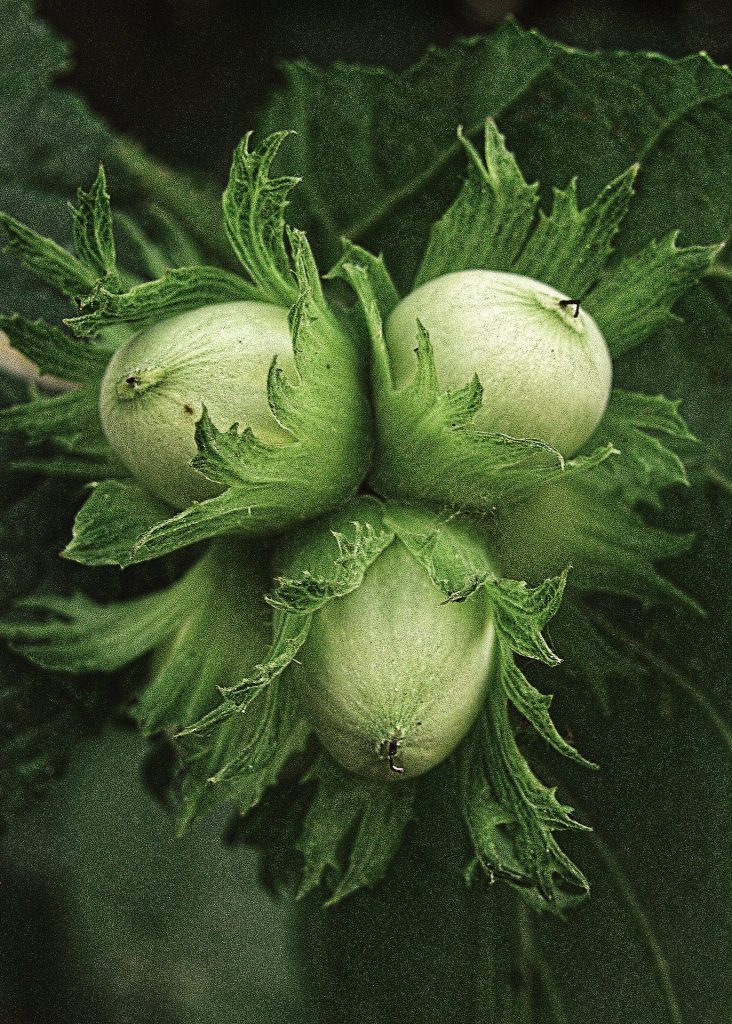
Filbert is simply another name for hazelnut, they are the same thing so the terms can be used interchangeably.
It’s likely the name ‘filbert’ cam from St Philbert’s Day which falls on 20th August, just as the nuts begin to ripen. But it may also come from ‘full beard’ referencing the green husk that covers the whole nut.
The nuts are celebrated at different times of the year though. In the US they nominate June 1st as National Hazelnut Cake Day (presumably using up the stocks from the previous year’s harvest) while in Italy December 14th is Hazelnut Day.
Filbert is the more common country term. Some growers have been known to say ‘We grow filberts, and sell hazelnuts’.
Hazelnut trading is one of the oldest trades. Officially termed a ‘Nocciolaia’ (from the Italian word for hazelnut), women would sell strings of nuts.
Filbert Folklore
Hazelnuts are ancient enough to have been eaten by dinosaurs. There’s evidence of nuts from the hazel tree being eaten by humans back to the Stone Age. On the Hebridean island of Colonsay a 9,000 year old midden was found to contain hundreds of thousands of burnt hazelnut shells. They may even have been trading processed hazelnuts with other communities.
So we can believe customs and stories about hazel and its nuts have come about through long association.
Hazelnuts are seen as a symbol of wisdom and knowledge. An ancient tale describes nine hazel trees growing around a sacred pool. Their nuts dropped into the water and were eaten by the salmon (a fish sacred to the Druids) who absorbed their wisdom. It is said that a Druid teacher caught one of these salmon intending to make himself omniscient. He asked a student to cook it for him. While doing so, the pupil accidentally blistered his thumb and sucked it cool, thereby absorbing the fish’s wisdom. The boy was called Fionn Mac Cumhail (Fin McCool) and went on to be one of the most heroic leaders in Gaelic mythology, creator of the Giant’s Causeway.
The Grimm brothers record fairy tales which rely on the protective properties of hazel. In ‘The Hazel Branch’ it is seen to offer the greatest protection from snakes and other things that creep on the earth. In ‘Cinderella’ the hazel branch planted by her mother’s grave grows into a tree where she can go to have wishes granted by the birds.
There is another folk story of ‘The Hazelnut Child’ in which a couple pray each day for a child, even one no bigger than a hazelnut. When their prayers are at last answered, the child indeed never grew larger than a hazelnut.
Meanwhile, catkins are symbols of fecundity and fertility. Associated with a long and happy marriage, catkins and hazelnuts have featured in wedding traditions throughout Europe. The Romans made celebratory torches using hazel tree branches.
Hazelnut is the symbol of the Revelations of Divine Love, written in the 14th Century by Julian of Norwich, the first book ever written in English by a woman.
Just proceed with caution on Nut Crack Night (the traditional Scots and Northern English name for Halloween). On this night, couples would throw pairs of hazelnuts into a fire to foresee how their marriage would last – burning steadily and quietly side by side; or popping, jumping and hissing.
Sacred and functional food
A Chinese manuscript dated to 2838BC references hazelnuts alongside the five sacred grains conferred upon human beings by God. Consuming these sacred foods endowed temple priests with powers of clairvoyance and insight.
An abundance of hazelnuts has always been considered beneficial. These days science can tell us even more about the benefits provided including folate, a B vitamin. This can help lessen the chance of heart attack and help rebuild damaged cells. They also have vitamin E which is an antioxidant and may help widen blood vessels leading to lowered blood pressure.
Greek philosopher Theophrastus (372 to 287 BC) wrote of their benefits; Greek physician Dioscorides (40 to 90 CE) recommended applying a mixture of hazelnut paste and suet on the head to ‘restore hair that fell away with alopecia’ – that would be a novel way to market Nutella!
Velvety oil
When you taste the creaminess of a hazelnut it’s perhaps not surprising to know that when the nuts are pressed, the oil that is expressed is wonderfully smooth and velvety. It can be used as an alternative to olive oil, having a slightly nutty taste and scent.
On the body, hazelnut oil soothes rough or tired skin and has an astringency that can help against acne. Generally good for toning and cell regeneration, it also shows another way in which hazel protects by providing a low level of SPF protection.
Leave a Reply