
Our last walk before the Spring equinox, nature’s start to spring, when the unfurling begins. A visit to the Rackleaze Nature Reserve (behind Tesco’s in Cam) was a chance to catch the awakening in action!
Promise of Spring
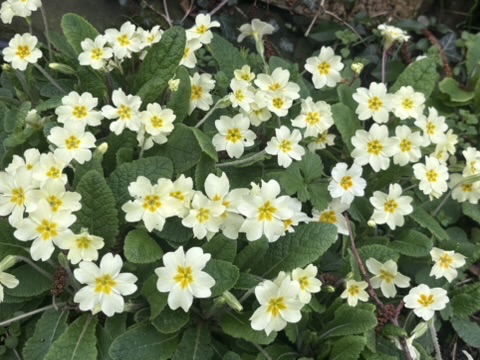
Appropriately, our first plant was Primrose (‘the prime rose’ or ‘first flower’) – an embodied promise, heralding spring. Primrose offers warm welcome, unfreezing even the deepest of winters. See how she is unaffected by frosts. She hugs the earth, connecting us with it and inviting us to step forward. Her gentle encouragement is never forceful, but always present. Look around you, primrose will not be far away, a faithful friend.
She’s been consistently relied upon to bring freshness to our diet, primrose can be tossed into a salad, floated on a drink or added to a traditional potage. Rarely used today by herbalists, primrose was once considered helpful against insomnia. Get close to her, inhale her scent, you’ll find she helps you breathe more easily, calming, soothing and softening.
Primrose’s cluster of flowers have been likened to a bunch of keys, and she does have an ability to unlock spaces within us. Take a look at her flowers – five heart-shaped petals, an abundance of love. And, should you happen to find a rare six-petalled primrose, it is believed you will be lucky in love.
Starry freshness
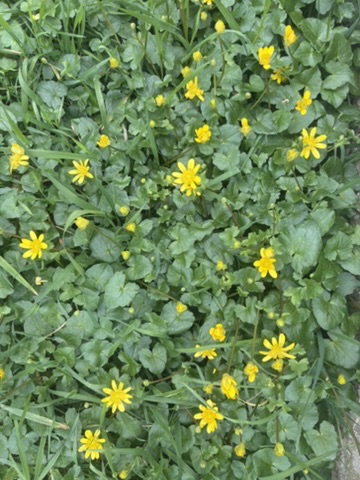
Alongside primrose, the starry yellow flowers of celandine. Another much appreciated boost of fresh green. Both leaves and flowers are edible, though a little bitter. The leaves in particular were a valuable source of vitamin C, eaten to deter scurvy. The roots must be cooked, but then are a little like sweet chestnut or tiny potatoes.
Always arriving in the last week of February, curiously, celanadine’s Latin name, chelidonia, refers to the swallow as they were supposed to appear together – presumably in more southerly regions than ours. The folk name is ‘Pilewort’ – take a look at the little balls her root tubers form and see if they remind you of haemorrhoids.
wort of the week
If you want to know more ‘worts’ (plants with a purpose), follow Cotswold Herb Centre on Instagram (@CotswoldHerbCentre) and you’ll get a weekly update. The word preceding ‘wort’ so often tells us something interesting about the plant’s history and previous uses.

Daffodil
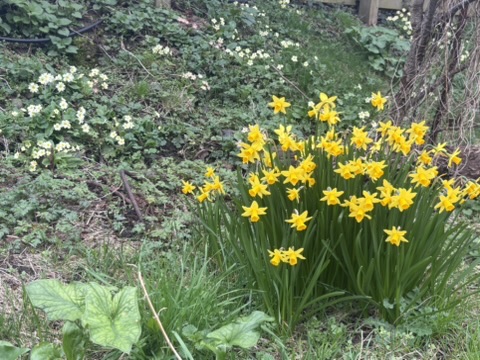
Of course another much-seen yellow flower of March is daffodil. This certainly isn’t edible, although the bulbs have sometimes dangerously been mistaken for onions. Again, it’s not one herbalists have much call for today but the bulb does have a traditional use of helping sore heels and may also be applied to other stiff or painful joints. In ancient times it was the basis of an ointment called ‘Narcissimum’ and Galen has praise for daffodil’s ability to help ‘draw forth thorns or stubs from any part of the body.’
Blackthorn
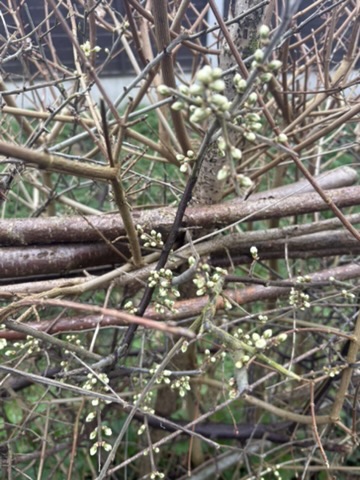
Perhaps a useful ally if you have a painful encounter with our next herb – blackthorn. Blackthorn is renown for her viciously long thorns (much larger than her hedge-sister, hawthorn). Hedgelayers would fear a nasty encounter with a blackthorn, her wounds typically prove hard to heal. Perhaps this is how she came to have a sinister connection with dark magic. Those thorns were used in sympathetic magic, stuck into poppets. Her branches would be used to craft wands (‘blasting rods’) for witches to cast curses.
In the Celtic Ogham, blackthorn is known as ‘Straif’, giving us the origin of our word ‘strife’. She has long been associated with trouble, flowering as she does in the dark half of the year. Characterised as ‘Mother of the Woods’ or the ‘Dark Crone’, blackthorn represents the waning of the year. The last of the cold. The term ‘Blackthorn Winter’ refers to those sharp turns in the weather, just when you think spring may be coming, we often get a final blast of cold. It feels like there’s a fight between winter and spring.
Much as this may make us shudder, we can also take solace in blackthorn. Her spiny thicket is intended to protect, and it is included within hedgerows for this purpose. A shelter for birds, defence against invaders, a protector of borders. In original versions of the Sleeping Beauty story, the thorny bushes that grew up around her castle were blackthorns. Think of blackthorn therefore as a source of strength and protection, her transformational magic able to help us through hardship and ‘dark’ times.
Blackthorn has been put to action as a branch over doorways to ward off evil spirits; as a simple amulet to guard against malicious magic; and as a walking stick to protect travellers on lonely roads.
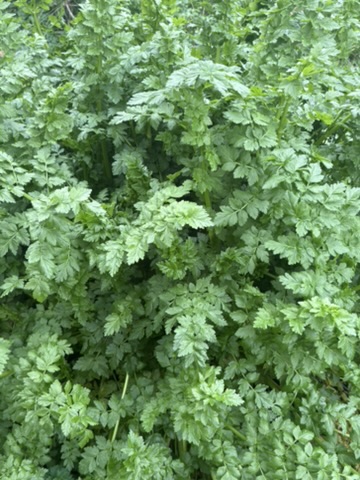
Hemlock Water Droplet
It’s not often that a herb hits the headlines, but this one’s been in the news recently. Roots have been washing up onto beaches, flushed from the soil by our heavy rains. Beware, their folk name is ‘dead man’s fingers’. Not only do the roots look like a bloated hand of a corpse, consuming the root is fatal, and thoroughly unpleasant in the process. In ancient times, in pre-Roman Sardinia, the root was consumed as a means to bring about ritual sacrifice. The unfortunate human being offered up would experience seizures, and their agonising grimacing has given us the phrase ‘Sardonic Grin’ which remains in our language to this day.
This is surely a reminder to not touch plants you don’t know; not to eat anything you can’t positively identify (usually with at least three different points of confirmation) and not to assume a pleasant smell and a leaf ‘a bit like parsley’ could suggest it’s edible. It isn’t. Every part of the plant is poisonous, even the sap can irritate the skin.
Let’s move away from the hemlock water droplet, and onto something we can enjoy …
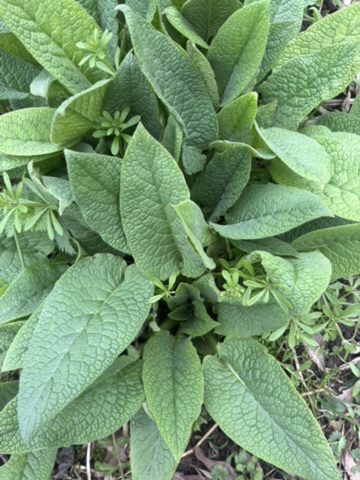
Let’s get comfrey
Comfrey is abundant across the Rackleaze nature reserve, volunteers work very hard to keep it from taking over entirely. However it is a wonderful resource for gardeners. Comfrey tea is one you make in bucket, not a teapot. Fill a bucket with leaves, cover with water, and leave for about six weeks. It will stink as the leaves rot down – put it somewhere you’ll not be passing every day or you’ll find yourself re-routing to a less smelly path.
Once an unctuous black liquid has formed, strain off any remaining solid (that can go on the compost) and bottle the juice. You’ll need to dilute this about 10:1 in a watering can before feeding to your plants. A once-a-week feed during the growing season will make a massive difference. The plants will thank you.
Comfrey’s folk name is ‘knitbone’, it’s also sometimes called ‘bruisewort’ (as are a few other plants too, confusingly). It’s Latin name is Symphytum officinale – the ‘officinale’ indicating it was listed in the official materia medica (i.e., used medicinally) and ‘Symphytum’ derived from the term ‘to unite’ (like our ‘symphony’). All this tells us it has a long history of being used to help fractures and sprains.
To benefit from this, one approach is to simply use comfrey leaves as a poultice bound onto the affected area. This is the way miners used comfrey when their knees became too sore to work, they’d wrap them in leaves until they were ready to return. Alternatively, make a comfrey oil by infusing comfrey leaves in sunflower oil (or olive oil, rapeseed oil, or other plant seed oils you may have available). After a few weeks you can strain off and bottle, the oil is ready to use whenever you need it.
The times they are a changing
To round off our time at Rackleaze we wanted to acknowledge the change that’s coming to our landscape and our community across neighbouring fields. While it may take some adjustment, we have confidence in the resilience of some of our favourite plants and hope they’ll endear themselves to many more people in coming years.
Here’s a poem from our very own Dr Viv to mark the changes we’re experiencing:
Comfrey amongst the cabbage
Those that know and love these fields
Will know the trees and plants as friends.
Blackthorn flowers announce the Spring
Elderberries at Autumn’s end.
The fields are home to St John’s Wort and hawthorn,
Field chamomile, yarrow and elecampagne.
Magnificent oak, birch, elder and hazel.
Nettle, dock, burdock and all types of plantain.
As humans put their inevitable stamp
Upon the earth in waves of destruction.
We rip out the hedges and destroy the plants,
Wildlife are homeless in the name of construction.
But, as new homes arise and new gardens planned
Flowers and vegetables grow front and rear.
Our friends will lie dormant beneath the soil
Waiting for their moment to reappear.
Have you tried removing nettle or dock?
They produce such prolific seed.
And all hail fluffy dandelion clocks,
Millions disperse on the breeze at speed.
Horsetail the fossil is a mare to remove,
Like brambles that are thorny and savage.
A mullein root can be four feet deep.
And I bet there’ll be comfrey amongst the cabbage.
Leave a Reply